


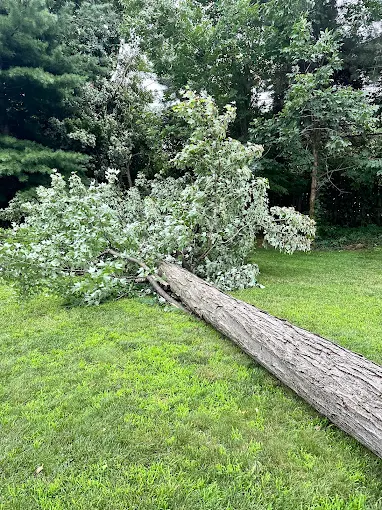
A tree came down in your yard, maybe onto the roof, maybe just flattening a fence, and now you're staring at a mess wondering whether your homeowners policy is about to bail you out or leave you covering the whole bill yourself. It's one of the most confusing corners of a homeowners policy, and the honest answer for storm damage tree removal claims is that it depends.
Tree removal insurance in Ohio isn't a single line item you can point to and expect a clean yes or no. Coverage typically hinges on what the tree hit, why it fell, and whether the cause counts as a covered peril under your specific policy.
That nuance matters because guessing wrong in either direction costs you. Assuming you're covered when you're not means an unpleasant surprise on the bill. Assuming you're not covered when you actually are means paying out of pocket for something your policy would have handled.
In this article, you will learn about:
- When homeowners insurance typically covers tree removal in Ohio
- What situations usually fall outside coverage
- How debris removal limits and deductibles affect your payout
- Special situations like rental properties and cars damaged by fallen trees
Keep reading so you know exactly what to check in your own policy before you call your insurance company.
When tree removal is typically covered
Most standard homeowners policies in Ohio are built around the idea of a covered peril, meaning a specific cause of damage the policy agrees to pay for. Wind, hail, lightning, and weight of snow or ice are common covered perils that show up in most standard policies, and a tree that falls because of one of these events is generally treated differently than one that simply gave out on its own.
The clearest scenario for coverage is a tree landing on something the policy insures. Emergency tree removal after a tree comes down on your house, garage, shed, or fence during a storm is usually covered, along with the structural repair itself.
- The tree fell due to a named covered peril like wind or lightning
- The tree damaged an insured structure, not just open yard space
- The event was sudden and accidental rather than the result of neglect
- Your policy includes the standard debris removal provision most homeowners policies carry
Coverage generally follows the damage, not just the presence of a downed tree. A tree that snaps in a windstorm and lands squarely on your garage is a very different claim than the same tree falling harmlessly across an empty section of backyard.
Ohio sees its share of the weather that triggers these claims. According to NOAA's National Centers for Environmental Information, Ohio recorded 69 severe storm events between 1980 and 2024 that each caused more than $1 billion in damage statewide, and the annual average for the five most recent years in that record climbed well above the long-term average. That frequency is part of why debris removal coverage exists as a standard feature on most policies in the first place.
What counts as a covered peril
Understanding which perils your policy actually names is the difference between a smooth claim and a denied one. Most standard homeowners policies list a specific set of covered perils rather than covering damage from any possible cause.
Windstorm and hail are the most common triggers for tree-related claims in Ohio, given how often severe weather rolls through the state. Lightning strikes, though less frequent, are also a standard covered peril and can directly kill or destabilize a tree even without an accompanying storm.
- Check your policy's declarations page for the specific list of named perils
- Confirm whether windstorm and hail are included as standard or require an endorsement
- Look for any exclusions specific to trees, which some policies carry separately from general storm coverage
- Note whether there's a separate deductible for wind or hail claims, since some Ohio policies apply a higher percentage deductible for these events
Reading through this list before a tree ever falls means you already know where you stand instead of scrambling to interpret policy language in the middle of a stressful situation.
Debris removal limits you should know about
Even when a claim is covered, most policies cap how much they'll pay specifically for debris removal, separate from the structural repair itself. This limit catches a lot of homeowners off guard because they assume covered means fully covered.
These limits vary by carrier and policy type, and they're worth confirming before you need them rather than after. Removing a large or hard-to-access tree can easily cost more than even a generous debris removal allowance covers, a gap that shows up clearly once you compare tree removal cost estimates against your policy's stated limit.
- A flat dollar cap per tree removed
- A separate cap for the total claim regardless of how many trees came down
- A percentage-based calculation tied to the overall damage amount
- Additional coverage available as an optional endorsement if the standard limit feels too low
If you know your property has several mature trees, it's worth asking your agent whether increasing this specific limit makes sense, rather than assuming the standard amount will stretch far enough if multiple trees come down in the same storm.
Structural damage versus yard damage
The line between a covered claim and an out-of-pocket expense often comes down to exactly what the tree touched. A tree that clips the corner of a roof triggers a very different response than the same tree falling three feet to the left and missing the house entirely.
Insurers draw this line consistently across most policies because coverage is tied to protecting insured structures, not the yard itself. A detached garage, a fence, and a shed generally count as insured structures the same way the main house does, even though people sometimes assume only the house itself qualifies.
- Direct damage to the house, garage, shed, or fence
- Damage to a detached structure specifically listed on your policy
- Partial damage, such as a tree resting against a wall without fully collapsing it
- Damage to landscaping features like a paver patio or retaining wall, which may fall under a separate provision
Confirming exactly which structures your policy lists as insured, beyond just the main house, helps you understand your real exposure before a storm ever tests it.
When tree removal typically isn't covered
Coverage gets a lot less certain once you move away from storm damage hitting a structure. Insurance is generally designed to respond to sudden, accidental events, not to routine maintenance or problems that developed slowly over time.
Preventative removal is the clearest example. If you decide to take down a tree because it's leaning, showing signs of disease, or just looks like it might eventually cause a problem, that's typically considered maintenance, and maintenance costs land on the homeowner, not the insurance company.
Maintenance and neglect situations
Insurance operates on the idea of insuring against the unexpected, and a tree that was visibly failing for months or years before it finally came down doesn't usually fit that definition. This distinction shows up constantly in how claims get evaluated.
A tree that falls purely due to age, rot, or long-term decline, without a specific storm event triggering the fall, is often treated differently than one that comes down during active severe weather. The insurer's argument in these cases is usually that basic upkeep, the kind covered in regular arborist consultations, should have caught the problem before it became a hazard.
- A dead or visibly declining tree removed as a precaution
- A tree that fell due to rot or disease with no storm involved
- Damage that resulted from a homeowner ignoring a known hazard
- Routine trimming, pruning, or landscaping maintenance
This is part of why staying ahead of tree health matters beyond just curb appeal. A tree that's clearly failing and gets flagged early, then removed before it falls, protects you twice: once from the physical risk, and once from an insurance argument you'd rather not have.
The neighbor's tree question
Trees don't respect property lines, and a tree from next door falling onto your property raises a different set of questions than one on your own land. Ohio generally follows a negligence-based approach here rather than automatically assigning blame based on whose yard the tree started in.
If a neighbor's tree was healthy and came down purely because of wind or weather, that's typically treated as an act of nature, and your own homeowners policy is usually the one that responds, the same as if the tree had been yours. Negligence changes that picture considerably.
- A healthy tree falling in a storm is generally act-of-nature, regardless of whose property it started on
- A visibly dead or hazardous tree that the neighbor ignored despite warnings shifts liability toward negligence
- Documentation matters if you've previously raised concerns about a hazardous tree next door
- Your insurer may pursue subrogation against the neighbor's policy in a negligence scenario, which doesn't require you to sue anyone directly
Keeping a simple record, photos, dated notes, or an email if you've flagged a concerning tree to a neighbor, gives you something concrete if a negligence question comes up later. It's not something you need often, but it matters when you do.
Excluded perils that catch homeowners off guard
Beyond maintenance and neglect, a handful of causes sit outside standard homeowners coverage entirely, regardless of how sudden or dramatic the event looked. These exclusions surprise people because the damage still feels like an act of nature, even when the policy treats it differently.
Flooding and earthquake damage are the two most common gaps. If a tree falls because rising water undermined its roots, standard homeowners coverage generally won't respond, since flood damage requires a separate policy. FEMA's National Flood Insurance Program currently serves more than 22,600 participating communities nationwide, and Ohio homeowners in a flood-prone area typically need to purchase that coverage separately rather than assuming their standard policy extends to it.
- Flood-related tree failure, which requires a separate flood policy through the National Flood Insurance Program or a private equivalent
- Earthquake-related damage, which needs its own endorsement in most standard Ohio policies
- Damage during a declared disaster where a specific exclusion applies
- Commercial or nursery-grown trees on a property used for that business purpose
Checking whether your policy carries these specific endorsements, particularly if your property sits near a floodplain, closes a gap that a standard windstorm conversation with your agent might not otherwise cover.
Filing a tree removal claim the right way
Once you know a claim might be covered, how you handle the first few steps can affect how smoothly it goes. Insurers expect a certain amount of documentation, and showing up prepared tends to move things faster.
Photos are the single most useful thing you can gather immediately, before any cleanup begins. Timestamped images of the tree, the damage, and the surrounding conditions give an adjuster a clear picture of what happened and when.
What to document before you call
Good documentation does double duty. It supports your own claim, and it protects you if there's ever a dispute about the extent of damage or the timeline of events.
Beyond photos, a written account while the details are still fresh matters more than people expect. Memory of exact timing and sequence fades quickly once the adjuster visit, contractor estimates, and cleanup all start happening at once.
- Take dated photos from multiple angles before any debris is moved
- Note the date and approximate time the tree fell, along with weather conditions
- Get a written estimate from a tree removal company before major cleanup, if it's safe to leave the tree in place briefly
- Keep any receipts for temporary repairs, like tarping a damaged roof
- Save copies of any communication with your insurer, including claim numbers and adjuster names
None of this needs to slow down safety-critical work. If a tree is blocking a driveway or threatening further damage, deal with the immediate hazard first and document as much as reasonably possible along the way.
Understanding your payout and deductible
Even a fully covered claim rarely means the insurer covers every dollar. Deductibles apply, and depending on your policy, coverage may be calculated as replacement cost or actual cash value, which changes what you actually receive.
Ohio's Department of Insurance publishes guidance explaining how coinsurance and underinsurance can reduce a payout even on a covered claim. According to the Ohio Department of Insurance's Homeowners Insurance Guide, if a home is insured for less than the required percentage of its replacement value, the insurer may pay only a matching reduced percentage of the repair costs, meaning the gap between a $1,000 damage claim and what actually lands in your account can be larger than expected even when the claim itself is approved.
- Your deductible applies before any payout, and some Ohio policies use a separate, higher deductible for wind and hail claims specifically
- Replacement cost coverage pays to rebuild or replace at current prices, while actual cash value factors in depreciation
- Underinsurance relative to your home's replacement value can reduce your payout percentage even on an approved claim
- Debris removal limits, discussed earlier, apply on top of these other calculations
Reviewing your declarations page for these specific numbers before you ever need to file a claim means fewer surprises when the moment actually arrives.
What to do if a claim is denied or underpaid
A denial isn't necessarily the final word, and plenty of homeowners successfully push back on an initial decision they believe was wrong. Understanding the dispute process ahead of time makes that pushback far more effective.
Start by asking the insurer specifically which policy provision led to the denial, in writing if possible. That answer tells you whether the dispute is about the cause of the damage, a coverage exclusion, or simply a disagreement over the value of the loss.
- Request a written explanation citing the specific policy language behind the denial
- Ask for a re-inspection if you believe the initial assessment missed damage or was rushed
- Get an independent estimate from a tree removal or contractor company to support your position
- Contact the Ohio Department of Insurance Consumer Services Division if you believe the company mishandled the claim
- Consider small claims court for disputes under the threshold that court handles, since it doesn't require a lawyer
Most disputes get resolved without ever reaching a regulator or a courtroom, but knowing these steps exist means you're not simply stuck accepting whatever the first answer happens to be. A written tree removal cost estimate from a licensed company carries real weight in these conversations, since it gives the adjuster a concrete number to compare against their own assessment.
Special situations that complicate coverage
Most claims fall into the straightforward categories already covered, but a handful of situations trip up homeowners more often than the rest. Knowing these ahead of time saves a lot of confusion if one of them ever applies to you.
Rental properties, blocked access, and trees that fall but don't touch anything each carry their own wrinkle. None of these situations are rare, and each one raises a slightly different question about whether and how coverage applies.
Trees that fall without hitting anything
A surprising number of homeowners assume a downed tree is automatically covered simply because it fell. In most cases, if the tree lands in open yard space without touching a structure, standard coverage doesn't apply at all.
This catches people off guard because the tree still needs to be removed, and removal isn't free just because nothing got damaged. Some policies offer limited exceptions, such as a tree blocking a driveway or a wheelchair ramp, but a tree simply lying across the lawn usually falls outside coverage entirely.
- A tree down in open yard space with no structural contact
- A tree blocking a driveway, which some policies cover under a limited exception
- A tree obstructing access for a disabled household member, sometimes covered separately
- Multiple trees down in the same storm with no damage to insured structures
If your situation falls into this gap, you're paying for tree removal out of pocket, best factored into any storm-preparedness budgeting for a property with several mature trees.
Rental and landlord property considerations
Coverage for a rental property doesn't follow the same rules as an owner-occupied home, and both landlords and tenants sometimes assume the wrong policy applies. A standard homeowners policy is written for an owner living in the home, and that assumption changes things once the property is rented out.
Landlords typically need a separate landlord or rental-property policy rather than relying on a standard homeowners policy, especially for anything beyond occasional short-term hosting. Tenants generally aren't responsible for tree removal at all, since the structure and grounds are the landlord's responsibility under most lease arrangements.
- Landlords generally need a dedicated rental or landlord policy, not a standard homeowners policy
- Short-term hosting through a home-sharing platform may require its own endorsement
- Tenants typically aren't liable for tree removal costs on a rented property
- Multi-unit properties may have different coverage structures per unit or building
Sorting out which policy actually applies before a storm hits avoids a confusing back-and-forth between landlord, tenant, and insurer right when a fast decision matters most.
Auto damage from a fallen tree
A tree landing on a parked car follows an entirely different insurance path than one landing on a house, and this trips up a lot of people the first time it happens. Homeowners insurance generally doesn't apply here at all.
Comprehensive auto coverage, not your homeowners policy, is what responds when a tree falls on your vehicle. That distinction matters because a homeowner with only liability auto coverage, no comprehensive, may find themselves with no coverage at all for that specific piece of the damage, even though the same storm is covered on the home side.
- Comprehensive auto coverage handles tree damage to a vehicle, not homeowners insurance
- Liability-only auto policies typically won't cover this type of damage
- You may need to file separate claims with two different carriers after one storm
- The vehicle's removal from the tree is generally handled as part of the auto claim, not the home claim
Checking whether your auto policy includes comprehensive coverage, separately from your homeowners policy, closes a gap that a lot of people don't discover until the worst possible moment.
Conclusion
Tree removal insurance in Ohio comes down to a fairly consistent pattern once you understand it: coverage generally follows sudden, weather-related damage to something your policy insures, while routine maintenance and neglect-related situations usually fall back on the homeowner. Knowing where your specific policy draws those lines before a tree ever falls puts you in a far stronger position when it actually happens.
Documentation, understanding your debris removal limits, and knowing the dispute process if something feels off round out the picture. None of it guarantees a smooth claim every time, but it stacks the odds in your favor.
If you're dealing with storm damage right now or just want a professional opinion on a tree that's starting to look risky, Premier Tree Specialists can take a look and help you figure out the right next step.
