


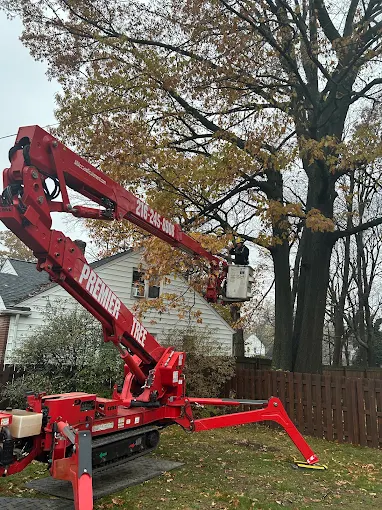
Tree trimming before fall in Portage County, OH can help homeowners address weak limbs, storm damage, clearance issues, and early signs of decline before colder weather adds more stress. The key is knowing which cuts help the tree and which cuts should wait for a better pruning window.
For homeowners in Kent, Ravenna, Streetsboro, Aurora, Mantua, Brimfield, Rootstown, and nearby Portage County communities, late summer and early fall are good times to inspect trees closely. Full foliage makes deadwood, thin canopy sections, heavy limbs, and storm damage easier to notice.
That does not mean every tree should be heavily pruned before fall. Some trees need light safety pruning now, while others are better scheduled for dormant-season work.
Premier Tree Specialists provides tree trimming and pruning, tree removal, stump grinding, emergency service, plant health care, and arborist consultations across Portage County and Northeast Ohio. A seasonal inspection can help you decide what should be handled before fall and what can wait.
In this article, you will learn about:
- Why timing matters for tree trimming before fall
- Which tree problems should be addressed before colder weather
- When to wait for dormant-season pruning
- How professional trimming improves safety and tree health
Keep reading to plan tree work that supports healthier trees and a safer yard.
Why timing matters for tree trimming before fall
Late summer and early fall are transition periods for trees. They are still carrying leaves, but they are also moving toward dormancy and preparing for colder weather.
That makes timing important. The right pruning can reduce hazards and improve structure, while unnecessary heavy cutting can stress a tree when it should be storing energy.
Late-season pruning should be selective
Before fall, trimming should focus on what has a clear purpose. That usually means removing dead, broken, hanging, rubbing, or hazardous branches rather than reshaping the entire canopy.
The University of Minnesota Extension says late dormant season is the best time for most pruning and also recommends removing dead or dying branches, rubbing branches, and storm-damaged limbs in its tree pruning guidance. That distinction matters because some problems should be corrected when found, while larger structural pruning is often better during dormancy.
For Portage County homeowners, the practical question is not “Can this tree be cut now?” It is “Which cuts are worth making now, and which ones should be planned for winter or early spring?”
Fall weather can expose weak limbs
As summer ends, trees may have already been through wind, heavy rain, pest pressure, drought stress, and full-canopy weight. A limb that held through July may be cracked, overextended, or weakened by the time fall storms arrive.
NOAA's National Severe Storms Laboratory classifies damaging thunderstorm winds as winds exceeding 50 to 60 mph in its damaging wind information. Branches with poor attachment, decay, or old storm cracks can become more dangerous when that kind of wind pushes through a full canopy.
Tree trimming before fall can reduce some of that risk when the work targets deadwood, broken branches, crossing limbs, and overextended growth. It does not make a tree storm-proof, but it can remove obvious weak points before the next weather shift.
Northeast Ohio conditions can change quickly
Portage County sits in a region where late summer heat, fall rain, early cold snaps, and winter storms can arrive close together. Trees that are already stressed may not have much margin if they enter fall with damaged limbs or poor structure.
Cleveland-area climate normals from the National Weather Service show 3.56 inches of normal August precipitation and an average August high of 82 degrees. That combination of warm weather and moisture swings can leave trees dealing with both growth stress and storm exposure before fall fully settles in.
This is why a late-season inspection is useful. You can spot obvious hazards now, then plan ideal-season pruning for branches that do not need immediate attention.
Which tree problems should be addressed before colder weather
Some tree problems should not wait for winter because they already affect safety, access, or the tree's ability to handle weather. The goal is to handle immediate concerns without over-pruning.
If you are unsure, look at the location of the branch, the size of the defect, and what it could hit. A small dead limb over a wooded edge is different from a cracked limb over a driveway.
Dead, broken, and hanging limbs come first
Deadwood and broken branches are the clearest pre-fall priorities. They can drop during wind, rain, leaf fall, ice, or snow, and they become harder to see once branches are bare or tangled with debris.
Hanging limbs are especially serious because they may already be detached or partially detached. They can shift without warning, even when the weather is calm.
Watch for hazards such as:
- Large dead limbs over the house, garage, driveway, or sidewalk
- Broken branches lodged in the canopy
- Cracked limbs attached near the trunk
- Branches rubbing against a roof, gutter, or siding
- Deadwood above a patio, play area, or parking space
These are the cuts that often justify trimming before fall, even when larger pruning should wait. Removing them can improve safety and prevent a small problem from becoming emergency cleanup.
If the limb is large, high, or under tension, do not try to pull it down from the ground. A professional inspection can determine whether the branch can be pruned safely or whether the whole tree needs a closer risk assessment.
Overextended limbs can create storm risk
Overextended limbs are long branches that carry too much weight far from the trunk. They may sag, crack, or fail during wind, snow, or ice.
These limbs are common in trees that have been neglected, topped in the past, crowded by nearby trees, or pushed toward sunlight. They can also develop after poor pruning creates weak regrowth.
Reduction cuts may help shorten heavy limbs while preserving the tree's natural structure. In some trees, crown reduction is safer than random limb removal because it targets weight and leverage instead of stripping the canopy.
Branches near homes and utilities need careful timing
Branches that touch roofs, siding, windows, gutters, fences, driveways, or service lines should be evaluated before fall storms and winter ice. Clearance problems can become more damaging when branches move in wind or carry wet leaves.
Tree work near utilities should never be treated like routine yard trimming. The risk is higher, and the right response may involve a qualified tree crew, the utility provider, or both.
If a tree is growing close to the house, clearance and structure should be considered together. Cutting one branch may not solve the larger issue if the tree's lean, roots, or canopy weight are moving toward the home.
When to wait for dormant-season pruning
Not every trimming request is urgent before fall. In many cases, the better answer is to inspect now and schedule pruning when the tree is dormant.
Dormant-season pruning can make it easier to see branch structure, reduce stress on many trees, and avoid some pest and disease pressure. That is especially important for larger cuts and structural work.
Oaks need extra caution
Oak pruning timing matters in Ohio because of oak wilt risk. Fresh pruning wounds can attract insects that spread the disease during warmer periods.
Ohio State's Buckeye Yard and Garden Line says the best way to protect oaks is to prune them when they are dormant, usually from October 15 to April 15, in its oak pruning guidance. For homeowners, that means late-summer oak pruning should be limited to safety needs unless an arborist recommends otherwise.
If an oak has a broken limb over a target, safety still comes first. The difference is that the cut should be handled carefully and intentionally, not as part of casual shaping.
Heavy shaping can stress trees late in the season
Large canopy reductions, aggressive thinning, topping, and unnecessary limb removal can stress trees before winter. Trees need leaves to produce energy, and removing too much live canopy at the wrong time can reduce reserves.
This is one reason proper pruning matters. The goal is not to make the tree smaller at any cost, but to improve structure, clearance, health, and safety with the fewest appropriate cuts.
If the tree is healthy and the work is mostly cosmetic, waiting may be the better choice. If the tree has deadwood, broken limbs, or branches over targets, selective trimming may still be appropriate before fall.
Some trees need a plan, not a quick trim
When a tree has decay, root damage, weak unions, or a major lean, trimming may not be enough. A quick cut can make the tree look cleaner without solving the real problem.
In those cases, an arborist should decide whether pruning, support, plant health care, monitoring, or removal makes sense. The recommendation should be based on tree condition and target risk, not only appearance.
If the tree has split unions or heavy limbs that cannot be safely reduced, support systems may be part of the discussion. If the trunk, roots, or canopy are too compromised, trimming may only delay a safer removal decision.
How professional trimming improves safety and tree health
Good trimming is not just cutting branches. It is choosing the right branches, making proper cuts, protecting tree structure, and avoiding damage that creates future hazards.
That is why professional tree trimming before fall is most useful when it is tied to inspection. The crew should understand what the tree needs now and what should be planned for the dormant season.
An arborist can separate urgent work from optional work
Homeowners often call because a tree looks overgrown, uneven, or too close to the house. An arborist looks for the safety and health details behind that appearance.
That may include branch attachment, canopy balance, trunk defects, root flare condition, deadwood, disease symptoms, and nearby targets. A certified arborist can help separate work that should happen before fall from work that can wait.
A professional recommendation may include:
- Removing dead, broken, or hanging limbs now.
- Scheduling structural pruning for the dormant season.
- Monitoring a stressed tree until spring.
- Treating pests, disease, or soil problems first.
- Removing a tree that cannot be made safe.
That sequence helps prevent overreaction. It also protects trees that are still healthy enough to keep.
If a tree is declining, plant health care may be more important than trimming alone. Pruning can remove damaged wood, but it does not correct soil compaction, disease pressure, root stress, or pest activity by itself.
Proper cuts protect the tree after pruning
Improper cuts can leave stubs, tear bark, remove too much live canopy, or damage the branch collar. Those mistakes can slow wound closure and invite decay.
The difference between trimming and pruning matters here. Routine trimming may sound simple, but the best results still depend on species, age, condition, growth rate, and the reason for the cut.
If you are preparing for fall, the best cuts are purposeful. Deadwood removal, clearance pruning, light reduction, and structural correction each solve a different problem.
Trimming can support winter preparation
Pre-fall trimming is one part of getting trees ready for colder weather. It can reduce obvious hazards, improve clearance, and identify trees that need follow-up before snow and ice arrive.
It should also fit with the rest of your seasonal plan. Mulch, watering, pest monitoring, disease checks, and structural inspection all affect how well trees handle the next season.
If your trees have storm damage, deadwood, or signs of stress, preparing them for winter should start before the first freeze. Waiting until branches are covered in ice or snow limits your options.
Conclusion
Tree trimming before fall can help Portage County homeowners reduce hazards, improve clearance, and prepare trees for colder weather. The best results come from being selective, not from cutting heavily just because summer is ending.
Dead, broken, hanging, rubbing, and overextended limbs are worth evaluating before fall storms and winter weather. Healthy trees that need larger structural pruning may be better scheduled during dormancy, especially when disease timing matters.
A professional inspection can help you decide what needs attention now and what should wait. That protects the tree's health while keeping your home, driveway, walkways, and outdoor spaces safer.
If you need tree trimming before fall in Portage County, Premier Tree Specialists can inspect your trees, explain the right timing, and provide a free quote for professional tree service.
