


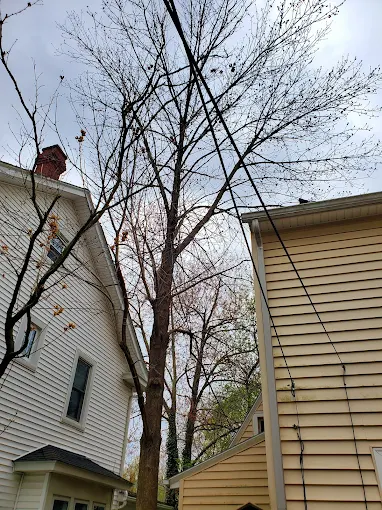
Warning signs your tree needs removal in Geauga County, OH can show up slowly, then become urgent after one hard storm, freeze-thaw cycle, or windy afternoon. A tree may still have leaves and look alive from the driveway while the trunk, roots, or major limbs are already losing strength.
That matters in places like Chardon, Chesterland, Bainbridge, Newbury, Burton, Middlefield, and nearby Geauga County communities, where mature trees often stand close to homes, barns, septic areas, driveways, roads, and utility lines. The question is not only whether the tree is declining, but what it could hit if it fails.
Some trees can recover with pruning, plant health care, or structural support. Others have crossed the line from manageable decline into a property hazard, especially when decay, root movement, major deadwood, or a new lean appears near a target.
Premier Tree Specialists provides certified tree care across Geauga County, including removal, pruning, stump grinding, emergency service, and arborist consultations. If you are not sure whether a tree can be saved, the right first step is a careful inspection before the problem becomes harder to control.
In this article, you will learn about:
- How to tell when tree decline is becoming a safety issue
- What trunk and root problems can mean for removal
- When storm damage changes the decision
- What to do before removing a hazardous tree
Keep reading to spot serious warning signs early and make a safer decision for your property.
How to tell when tree decline is becoming a safety issue
Tree decline does not always mean immediate removal. A tree can lose a few limbs, struggle during drought, or show seasonal stress and still respond well to proper care.
Removal becomes more likely when several warning signs appear together or when one major defect affects the tree's ability to stand. A dead branch over a field is different from a dead branch over a bedroom, parked car, sidewalk, or power line.
Large sections of deadwood deserve attention
Deadwood is one of the most visible signs that a tree is losing usable living tissue. Small dead twigs are common, but large dead limbs in the upper canopy can drop without much warning.
If one side of the canopy is bare while the rest of the tree is leafed out, the problem may be more than ordinary branch loss. It can point to root damage, vascular decline, disease, old storm injury, or decay spreading through one side of the tree.
Watch for patterns like these:
- Large dead limbs over the house, garage, driveway, or play area
- A canopy that leafs out unevenly in spring
- Branches with peeling bark and no buds
- Repeated limb drop during calm weather
- Dead sections concentrated on one side of the tree
These signs do not automatically mean the tree must come down, but they do mean the tree should be evaluated. If dead limbs are paired with trunk decay, root lifting, or a new lean, the removal conversation becomes much more serious.
Another useful clue is how quickly the canopy changed. A tree that declined over several years may have a different prognosis than one that lost a major section in a single season.
Bark loss, cracks, and cavities can reveal deeper damage
Bark protects the living tissue beneath it. When bark falls off in large sheets, separates from the trunk, or exposes dry wood underneath, the tree may already have significant internal stress.
Cracks and cavities deserve the same caution. A small surface wound can close over time, but a long vertical crack, open cavity, or hollow-sounding trunk can weaken the stem that holds the canopy upright.
Look closely at the trunk before assuming the canopy tells the whole story. A tree may carry green leaves for a while even when the central column is compromised.
Fungal growth can be a decay clue
Mushrooms near the base, shelf-like conks on the trunk, or fungal growth around old wounds can indicate decay. The important detail is location, because fungi at the root flare or on a major stem can matter more than mushrooms scattered in mulch.
Decay does not always mean the tree is ready to fall today. It does mean the tree's strength may be reduced, especially if the decay is paired with cavities, carpenter ant activity, large wounds, or dead limbs above the same area.
If fungal growth appears with canopy thinning or bark loss, take photos and have the whole tree assessed. Treating the visible symptom without checking the structure can leave the real hazard in place.
What trunk and root problems can mean for removal
The trunk and root system carry the entire load of the tree. When either one is compromised, pruning alone may not be enough to reduce the risk.
This is where homeowners should be careful about relying only on what they can see from the road. Many hazardous trees still look familiar until a closer inspection reveals soil movement, root decay, trunk separation, or a defect hidden behind the canopy.
A new lean is different from an old lean
Some trees grow at an angle for years and remain stable because they have adapted over time. A new lean after wind, heavy rain, excavation, or soil movement is a different concern.
Look for fresh soil cracks, raised turf, exposed roots, or a gap on one side of the trunk flare. Those signs suggest the root plate may have shifted, which can make the tree less stable even if the trunk is still intact.
The National Weather Service defines a severe thunderstorm as one capable of producing wind gusts over 58 mph or hail at least 1 inch across. Wind at that level can break large limbs, knock trees over, or damage a tree's structure enough that the lean becomes noticeable after the storm.
Root damage can make a healthy-looking tree unsafe
Roots do more than absorb water. They anchor the tree, stabilize the trunk, and help the canopy withstand wind.
Root problems can come from trenching, grade changes, soil compaction, drainage issues, driveway work, construction, or long-term decay near the base. A tree with green leaves can still be unsafe if enough anchor roots have been cut or weakened.
Pay attention to root-zone warning signs such as:
- Soil lifting on one side of the tree
- Cracks spreading through the ground near the trunk
- Exposed roots that appear torn or decayed
- Mushrooms clustered near the root flare
- Recent digging, grading, or heavy equipment traffic nearby
These signs matter more when the tree is close to the house, garage, road, septic field, or overhead lines. A professional inspection can connect the visible symptoms to the tree's actual stability.
If the root zone has changed recently, do not park equipment or stack debris over it while you wait for service. Extra soil pressure can make an already stressed tree harder to evaluate and may worsen root damage.
Split trunks and weak unions can fail suddenly
A split trunk is one of the clearest signs that a tree may need removal. Once the main stem separates, the tree may no longer be able to distribute weight safely.
Weak unions are also a concern, especially where two large stems meet at a tight angle. Bark can become trapped between the stems, leaving a weak connection that opens during storms or heavy snow.
Some weak unions can be managed with pruning or support systems. If the split is active, deep, or aimed toward a target, removal may be the safer recommendation.
When storm damage changes the decision
Geauga County trees deal with wind, heavy rain, lake-effect snow, ice, saturated soil, and freeze-thaw cycles. A tree that was only borderline before a storm can become hazardous after one major weather event.
Storm damage also creates hidden risk. The limb on the ground is obvious, but the cracks, root movement, and torn branch unions still in the canopy can be more dangerous.
Major canopy loss can make recovery unlikely
Storm damage should be judged by the whole tree, not just the largest broken limb. The amount of living canopy left after the storm tells you a lot about whether the tree has enough structure and energy to recover.
Iowa State University Extension notes that large trees that have lost 50 percent or more of their canopy, trees with split trunks, and trees that are leaning and partially uprooted are often removal candidates in its guidance on damaged trees. Trees with minor crown damage or a few broken side branches may be savable with proper pruning.
That 50 percent threshold is not a replacement for an on-site evaluation, but it is a useful warning sign. If half the canopy is gone, the tree may struggle structurally and biologically even after cleanup.
Local storms have already shown what tree failure can look like
Northeast Ohio has seen how quickly severe weather can turn tree defects into property damage. During the August 6, 2024 severe weather event, NWS Cleveland reported five EF-1 tornadoes and more than 400,000 residents without power across the region.
That same event included a Kirtland-Chesterland tornado in Lake and Geauga Counties with estimated peak winds of 110 mph and a 4.79-mile path. The survey described extensive tree damage, including uprooted and snapped trees along the path.
For a homeowner, the lesson is not that every storm-damaged tree needs removal. The lesson is that a cracked, leaning, hollow, or partly uprooted tree should not be treated like ordinary yard debris.
Branches near targets raise the urgency
A damaged tree becomes more urgent when it can hit something important. Targets include people, houses, vehicles, sheds, barns, fences, driveways, sidewalks, utilities, and neighboring property.
The same defect may lead to different recommendations depending on location. A dead limb over a wooded back lot may be monitored, while the same limb over a walkway may need prompt removal.
If a tree is blocking access, resting on a structure, or creating an immediate hazard, keep people away from the area and call for help. Do not try to pull down hanging limbs or cut storm-loaded wood from the ground.
What to do before removing a hazardous tree
Once you suspect a tree may need removal, slow down enough to protect yourself, your property, and the trees that might still be saved. A careful process can prevent unnecessary removal and reduce the risk of a dangerous cleanup.
The goal is to identify the hazard, document what changed, and get a recommendation based on the tree's condition and location. That is especially important in Geauga County, where larger lots, wooded edges, septic areas, and long driveways can make access and rigging more complicated.
Document the signs from a safe distance
Take photos before anyone starts cutting, especially if the tree was damaged by a storm or has hit a structure. Wide photos show the lean and target area, while close photos show cracks, cavities, roots, or broken limbs.
Do not stand under hanging branches to get a better picture. Use zoom, step back, and take photos from multiple angles instead.
Use a simple note list:
- When you first noticed the problem.
- Whether the lean, crack, or dead section is new.
- What the tree could hit if it failed.
- Whether recent storms, construction, trenching, or flooding affected the area.
- Whether limbs have fallen before.
Those details help an arborist understand urgency before the on-site evaluation. They can also help you remember changes that may be easy to miss once cleanup begins.
Keep pets, children, vehicles, and lawn equipment away from the target zone until the tree is evaluated. A tree that is already shifting should not be bumped, tied, pulled, or used as an anchor point.
Ask whether pruning, treatment, or support could still work
Removal is sometimes the right answer, but it should not be automatic just because a tree looks rough. Some trees with localized damage can be preserved with pruning, plant health care, or structural support.
The deciding factors include species, age, trunk condition, root stability, canopy loss, disease pressure, and what the tree could hit. A certified arborist should be able to explain why removal is recommended or why another approach is reasonable.
If the tree can be made safe, pruning may be enough. If decay, root failure, or trunk separation has changed the tree's structure, removal may be the more responsible choice.
Plan the removal around access and cleanup
Tree removal is safer when the crew can plan access, rigging, equipment placement, traffic flow, debris handling, and stump work. A hazardous tree close to a house or utility line is not the same job as a small tree in an open yard.
Ask what will happen to the wood, brush, stump, and surrounding lawn. If the tree is near a septic field, driveway, slope, fence, or garden bed, those details should be discussed before work starts.
For Geauga County properties with mature trees, removing one hazardous tree may also reveal risks in nearby trees. After the dangerous tree is handled, an arborist can help you decide whether adjacent trees need pruning, monitoring, or plant health care.
Conclusion
A hazardous tree rarely becomes dangerous out of nowhere. Most trees show warning signs first, such as deadwood, bark loss, trunk cracks, cavities, fungal growth, root movement, storm damage, or a new lean.
The key is knowing when those signs point to routine care and when they suggest a serious structural problem. If the tree is close to your home, driveway, barn, utility line, or neighbor's property, even one major defect can raise the stakes.
Some trees can still be saved with pruning, treatment, or support. Others need removal before the next storm, snow load, or soil shift turns a visible warning sign into property damage.
If you are seeing warning signs on a tree in Geauga County, Premier Tree Specialists can inspect the tree, explain your options, and provide a free quote for safe tree service.
