


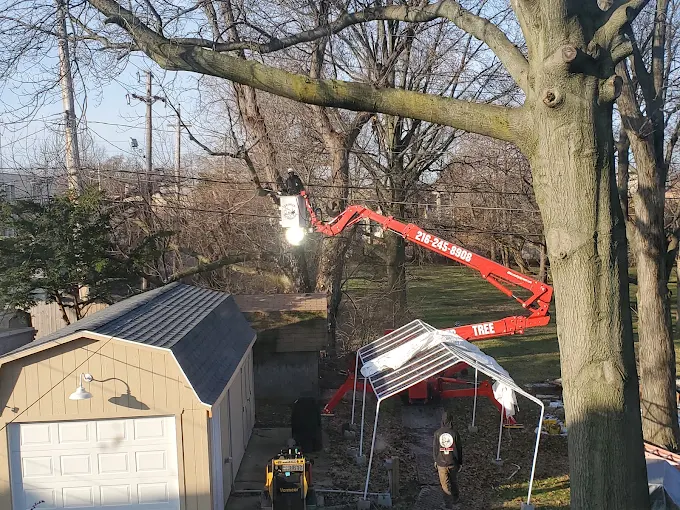
A dead tree is not just an eyesore. In Fairfield County, it is a structural hazard that gets more dangerous with every season it is left standing. Most homeowners assume a dead tree will signal its own decline gradually, giving them plenty of time to schedule removal. That is not how it works.
Once a tree dies, the wood begins losing structural strength almost immediately. Roots decay from the outside in. Internal wood softens and hollows. The root system that once anchored hundreds or thousands of pounds of trunk and branch weight starts breaking down, and the tree becomes far less stable than it looks from the street. A tree that appears solid can fail without warning during a wind gust, an ice event, or even on a calm afternoon.
The dead tree warning signs that matter most are often structural, not visual. Ohio homeowners in Fairfield County need to understand the actual risk timeline, what the consequences of waiting look like, and what to do when they suspect a tree on their property has died.
In this article, you will learn about:
- How a dead tree deteriorates and why the timeline is faster than most people expect
- The specific risks dead trees create for property, utilities, and people
- What the warning signs of a dead or dying tree actually look like
- How insurance and liability factor into the decision to remove
- When to call a certified arborist versus waiting for "a better time"
Keep reading to understand why prompt dead tree removal in Fairfield County is not just good practice but a genuine safety obligation.
A dead tree does not just stand there
The assumption that a dead tree stays stable until it obviously falls apart is one of the most dangerous misconceptions in property maintenance. In reality, a standing dead tree in central Ohio is in an active state of physical deterioration from the moment it dies.
Wood decay begins when bark can no longer protect the underlying structure from moisture and fungal intrusion. According to USDA Forest Service research on wood decay in trees, decay progresses through stages that compromise structural components, including cellulose and lignin, over time. In conditions with consistent moisture, as Fairfield County reliably provides through spring rains and summer humidity, fungal activity accelerates dramatically once moisture content in dead wood climbs above 20 percent.
At that threshold, wood strength declines at a rate that is not visible from the outside.
The deceptive part is the exterior. Dead bark can remain largely intact for one to two years after a tree dies, giving the surface a stability it no longer has internally. By the time cracks appear and bark plates start separating, the structural wood inside may already be compromised far beyond what could safely hold the weight of the canopy.
Why Fairfield County's climate speeds up the clock
Ohio's climate is not kind to standing dead wood. Fairfield County sees a full four-season cycle: wet spring thaws, humid summers, freeze-thaw autumn cycles, and ice events in winter. Each of those cycles accelerates decay in a different way.
Spring moisture saturates dead wood and fuels fungal colonies. Summer heat provides ideal temperatures for those colonies to reproduce. Fall's freeze-thaw cycles create micro-fractures in the wood structure, expanding cracks that already exist. Winter ice storms add hundreds of pounds of load to limbs that have been losing tensile strength for months.
The result is a tree that may have looked stable in September and becomes a legitimate falling hazard by January. Fairfield County homeowners who notice a dead tree in late fall and decide to wait until spring are making a decision during the most physically damaging period of the year for that tree's structure.
The root system is failing, too
What makes a standing dead tree especially dangerous is that the failure is not always in the trunk. Roots decay from the outside in, and the anchor capacity of a dead root system can drop significantly before any above-ground symptoms appear.
A dead tree with a compromised root system can topple at the base rather than break mid-trunk. This type of failure happens faster, without the visible warning signs homeowners look for, like a cracked limb or separated bark. It also tends to bring a larger section of the tree down in a single event, often across a wider area than a simple limb fall would cover.
What a falling dead tree actually hits
The hazard a dead tree poses depends almost entirely on what is within its fall radius. In a rural field, a falling tree is a minor problem. In a residential lot in Fairfield County, the fall radius of even a mid-sized tree typically includes a roof, a vehicle, a fence, a utility line, or a neighboring property.
OSHA data cited by legal researchers indicates that over 100 people are killed by trees annually in the United States. That figure covers all tree failures, but dead and structurally compromised trees account for a disproportionate share of residential incidents. The unpredictability of a decayed tree is what makes it more dangerous than a structurally sound tree in a storm.
Fairfield County's residential areas mix older neighborhoods with established large trees close to homes, driveways, and property lines. Lancaster and surrounding communities have mature tree canopies that were planted decades ago. Many of those trees are now at the end of their natural lifespan, and some have died from disease, drought stress, or pest damage without the homeowner recognizing what has happened.
Structures and vehicles in the fall zone
When a dead tree falls on a structure, the damage is rarely minor. Roof penetration, wall collapse, and damage to HVAC equipment or vehicles parked in the driveway are all common outcomes. Repair costs for a tree falling through a roof can run from $10,000 to $50,000 or more depending on the size of the tree and the section of the structure affected.
What homeowners do not always consider is how fall direction is determined. Wind at the time of failure plays a role, but so does the lean of the trunk, the distribution of remaining canopy weight, and where root decay is most advanced. An arborist can often predict the most likely fall direction during an inspection. A homeowner looking at the tree from the yard cannot.
Understanding which trees on your property are too close to the house is a useful starting point. When one of those trees is also dead or dying, the priority for removal moves up considerably.
Utility lines and secondary hazards
Dead trees near power lines create a compounding problem. A tree that falls into a utility line does not just create property damage. It can cause a power outage affecting a neighborhood, create a downed-line fire hazard, and generate liability far beyond the cost of the tree itself.
Ohio utility easements generally require homeowners to keep trees clear of distribution lines on their property, and a dead tree that contacts a line during a storm can draw a utility company's attention and a potential bill for line restoration. Removing the tree before that happens is significantly cheaper than managing the aftermath.
What the warning signs look like before total failure
Dead and dying trees do not always announce themselves clearly, but there are patterns homeowners can learn to recognize. Catching the transition from alive to dead, or from dead to structurally failing, is the window where proactive removal avoids an emergency.
The most reliable indicators that a tree has died or is failing structurally include:
- No leaf production in spring across the full canopy, or only sparse leaf-out in small sections
- Bark that is peeling away in large plates and exposing dry, gray wood underneath
- Mushroom or conk growth at the base of the trunk or on major roots, which indicates internal fungal decay
- Dead branches accumulating on the ground beneath the tree between storms
- A trunk that produces a hollow sound when struck with a firm object
- Visible cracks running vertically along the trunk, especially near branch attachments
- Woodpecker activity concentrated on one section, which often signals insect colonization of dead wood
Any single item on that list warrants a professional evaluation. Multiple items together describe a tree in active failure progression. The USDA Forest Service notes that dead trees can fall without warning, and that visible cracks, absent bark, and fungal growth are among the most reliable pre-failure indicators.
The difference between dead and dormant
One complication for Fairfield County homeowners is the dormant season. Between late November and early April, a deciduous tree that has lost all its leaves is easy to misread as dead. The difference between a dormant tree and a dead one takes more than a visual check.
Scratch a small section of bark near a live twig. Healthy dormant wood will show green or cream-colored tissue underneath. Dead wood shows dry, brown, or gray tissue that has no moisture. Live twigs flex slightly without snapping. Dead twigs are brittle and break cleanly under light pressure.
A certified arborist inspection in late winter or early spring, before leaf-out, is the most reliable way to determine the actual status of a tree that looks questionable. Arborists use probes, resistance measurement tools, and their knowledge of species-specific decay patterns to make accurate assessments that a surface visual cannot match.
Insurance, liability, and the cost of waiting
Insurance companies treat dead trees differently from healthy trees that fail in a covered weather event. When an insurer investigates a storm-damage claim involving a tree, one of the first things they look for is the pre-storm condition of the tree.
A tree that was dead or visibly declining before the storm may result in a denied or significantly reduced claim. The reasoning is that the homeowner had a known hazard and failed to address it. Damage from a healthy tree that failed unexpectedly during a covered event is treated differently than damage from a dead tree that was overdue for removal. This distinction costs homeowners thousands of dollars in claim settlements every year.
There is also a neighbor liability angle. If a dead tree on your property falls onto a neighboring home or vehicle, and it can be demonstrated that the tree was visibly dead before the event, you face personal liability for those damages. Ohio courts have held property owners responsible for tree-related damage when negligence or failure to maintain a known hazard can be established.
What removal actually costs versus the risk it eliminates
Dead tree removal costs vary by size, location, and access. A straightforward removal on an open lot is far less expensive than an emergency call after a tree has already come down. Emergency removals typically carry a premium for after-hours response, immediate cleanup, and the added complexity of working around existing damage.
The cost gap between scheduled removal and emergency removal is one of the clearest financial arguments for acting before a dead tree fails on its own.
After removal, stump grinding handles what is left at grade. Leaving a stump from a dead tree in place is not a neutral outcome. The decaying root system can continue spreading fungal disease to nearby healthy trees, and the stump itself becomes a breeding ground for wood-boring insects that will move on to living hosts once the dead wood is fully colonized.
Calling an arborist: what the inspection covers and what comes next
Once a Fairfield County homeowner suspects a tree has died, the right next step is a professional evaluation, not a second round of waiting to see what spring brings.
A certified arborist approaching a potentially dead tree is assessing several things at once. The visible crown condition gives preliminary information, but the real evaluation happens at the trunk and root flare. An arborist looks for:
- Root flare condition and evidence of basal decay
- Trunk wound closure status and evidence of fungal intrusion
- Wood density testing with a probe or mallet to detect hollow sections
- Branch attachment strength in the upper canopy
- Evidence of primary disease or pest infestation that may have caused the death
The assessment produces a clear answer: the tree is dead and should be removed, it is dying and has a projected timeline, or it is dormant and healthy. That answer drives a concrete action plan rather than continued uncertainty.
When removal is confirmed, the arborist can also assess the fall zone, determine the safest felling approach, and identify whether any adjacent living trees show signs of the same disease or pest pressure that killed the dead one. This is important in Fairfield County, where emerald ash borer, oak wilt, and other regional issues can affect multiple trees on a single property.
The benefits of scheduling regular arborist visits extend well beyond emergency situations. Catching a tree in its decline phase, before it crosses into dead-and-dangerous territory, is the point at which the most options remain available and the costs are lowest.
Permits and the removal process in Fairfield County
Some municipalities in Fairfield County require a permit before removing trees above a certain size or in certain locations. Lancaster and other incorporated communities may have their own ordinances. An experienced local arborist will know the current permit requirements for your specific address and can handle that process as part of the job.
If you are unsure whether a permit is required before removal, check with your municipality directly. The permit process rarely takes long enough to justify delaying removal of an actively hazardous tree, and an arborist can help expedite the process when public safety is the reason for urgency.
Conclusion
A dead tree in Fairfield County, OH is not a problem that holds still. It decays, loses structural integrity, and becomes more dangerous with every rain, every freeze, and every wind event. The homeowners who end up dealing with emergency removals, denied insurance claims, and neighbor disputes are almost always the ones who saw the signs and decided to wait.
The decision to remove a dead tree is not complicated once you understand what you are actually managing. It is a weight-bearing structure with a compromised foundation, standing over everything you own and everyone who lives on your property. The question is not whether to remove it. It is whether to do it on your schedule or the tree's.
Premier Trees serves Fairfield County with certified arborist inspections and full-service dead tree removal. Contact the team to get an assessment and a clear plan before the next storm makes the decision for you.
