


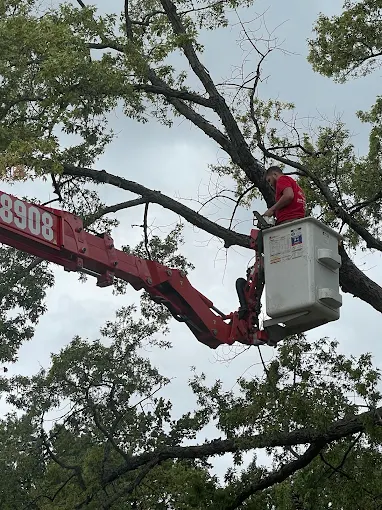
To prevent falling branches in Summit County, OH, homeowners need to look for weak limbs before late-summer storms, leaf weight, and early fall weather expose the problem. A branch can look stable from the ground while cracks, decay, poor attachment, or hidden storm damage are already making it more likely to fail.
For homeowners in Akron, Cuyahoga Falls, Stow, Hudson, Green, Barberton, Tallmadge, Twinsburg, and nearby Summit County communities, late summer is a practical time to inspect trees. Leaves are still on the canopy, recent storm stress is easier to spot, and there is still time to schedule selective work before colder weather.
The safest strategy is not to cut every branch that looks large. It is to identify the branches most likely to fall, understand what they could hit, and decide whether pruning, support, plant health care, or removal is the right next step.
Premier Tree Specialists provides tree trimming and pruning, tree removal, stump grinding, emergency service, plant health care, and arborist consultations across Summit County and Northeast Ohio. A late-summer inspection can help you reduce obvious hazards without over-pruning healthy trees.
In this article, you will learn about:
- Why branches fall more often in late summer
- Which warning signs deserve attention before the next storm
- How pruning and tree care reduce branch failure risk
- When falling branch concerns need professional help
Keep reading to make your yard safer before late-summer weather turns small defects into bigger problems.
Why branches fall more often in late summer
Late summer can be tough on trees because the canopy is still full, storms can arrive quickly, and earlier seasonal stress has already built up. Branches that were weakened in spring or early summer may not fail until wind, rain, or added leaf weight pushes them past their limit.
The goal is not to predict every failure. The goal is to notice the conditions that make falling branches more likely and handle the branches that pose the clearest risk.
Full canopies catch more wind
A leafy canopy gives wind more surface area to push against. That can increase stress on overextended limbs, cracked unions, and branches weakened by decay.
NOAA's National Severe Storms Laboratory classifies damaging thunderstorm winds as winds exceeding 50 to 60 mph in its damaging wind information. Branches with poor structure or hidden cracks are more likely to become a problem when gusts reach that range.
This is why a tree that looks fine on a calm day can drop limbs during a strong late-summer storm. Wind does not need to uproot the whole tree to cause serious damage.
Heavy rain can add weight and soften the root zone
Rain affects both the canopy and the soil. Wet leaves and branches are heavier, and saturated soil can reduce stability around trees with shallow, damaged, or compacted roots.
Cleveland-area climate normals from the National Weather Service show 3.56 inches of normal August precipitation and an average August high of 82 degrees. That warm, wet pattern can leave Summit County trees dealing with both growth stress and storm pressure late in the season.
Moisture does not make every tree hazardous. It does make existing weaknesses more important, especially when branches are over a roof, driveway, sidewalk, patio, or play area.
Old damage can fail weeks later
Branches do not always fall immediately after they crack. A limb may split during one storm, hang in the canopy, then drop during the next round of wind or rain.
That delayed failure is one reason late-summer inspections matter. You may find damage from storms that happened days or weeks earlier, especially if the broken branch is lodged high in the canopy.
If you notice repeated limb drop, new cracks, or a branch hanging lower than it used to, look beyond the one branch. The same tree may also have structural weaknesses that deserve a closer inspection.
Which warning signs deserve attention before the next storm
The most important branch hazards usually have visible clues. You do not need to diagnose the whole tree from the ground, but you can learn which signs mean it is time to stop using the area beneath the tree and call for help.
Pay attention to the branch itself, the point where it connects, and the condition of the tree around it. Falling branches are often symptoms of a bigger structural or health issue.
Deadwood is the first thing to look for
Dead branches are brittle and less flexible than living wood. They can break during wind, drop during calm weather, or shed smaller pieces over time.
Look for branches with no leaves, peeling bark, fungal growth, or smaller twigs that snap easily. If one side of the canopy is dying back, the problem may involve roots, disease, old storm damage, or trunk decay.
Common red flags include:
- Large dead limbs over the house, garage, driveway, or sidewalk
- Bare limbs surrounded by healthy foliage
- Branches with peeling bark and no buds
- Repeated limb drop during calm weather
- Deadwood above a patio, playset, fence, or parking area
These signs matter most when they appear near people or property. A dead limb deep in a wooded edge may be less urgent than a dead limb over a place your family uses every day.
If the tree also has trunk cavities, mushrooms near the base, or bark loss, canopy dieback may be part of a larger decline pattern.
Cracks and weak unions can split suddenly
Weak unions form where limbs or stems attach poorly. Tight V-shaped unions can trap bark between stems, which reduces the strength of the connection.
Cracks near a branch union are especially concerning because they can widen quickly during wind. The branch may not fall right away, but the connection is no longer behaving like healthy wood.
Look for fresh pale wood, vertical splits, bark squeezed between stems, or a branch that appears to be pulling away from the trunk. These defects should be evaluated before the next storm if they are near a target.
Overextended limbs can carry too much leverage
An overextended limb is a long branch that carries weight far away from the trunk. The farther the weight extends, the more leverage the limb has during wind, rain, or snow.
These limbs are common on trees that have been crowded, topped, or pruned poorly in the past. They can also develop naturally when a tree reaches toward sunlight.
In some cases, crown reduction can reduce weight and leverage without stripping the tree. Random limb removal can make the tree weaker, so the cut location matters.
How pruning and tree care reduce branch failure risk
Preventing falling branches is not about making the tree bare. It is about removing clear hazards, improving structure, and protecting the tree's ability to recover after cuts.
Good pruning should preserve the tree's natural form while reducing the branches most likely to fail. Poor pruning can create fast-growing weak shoots, large wounds, and new hazards.
Selective pruning removes the right hazards
Selective pruning targets dead, broken, rubbing, cracked, diseased, or overextended branches. It is different from topping or thinning the canopy until too much live growth is gone.
The National Weather Service uses 58 mph wind gusts, hail at least 1 inch across, or a tornado as severe thunderstorm criteria in its thunderstorm safety information. Selective pruning cannot make a tree storm-proof, but it can reduce obvious weak points before severe weather arrives.
The most useful cuts are usually tied to a specific reason. A branch is removed because it is dead, cracked, rubbing, poorly attached, diseased, or too close to a structure.
Pruning timing should match the tree
Some branch hazards should be handled when found, especially deadwood or cracked limbs over targets. Other pruning is better scheduled during the dormant season.
The University of Minnesota Extension says late dormant season is the best time for most pruning and recommends removing dead or dying branches, rubbing branches, and storm-damaged limbs in its tree pruning guidance. That means late summer is a good time to inspect and correct hazards, while larger structural pruning may be planned for later.
If you are unsure whether a tree needs trimming now or later, proper pruning depends on species, condition, season, and the reason for the cut.
Tree health affects branch strength
Branches fail more easily when the whole tree is stressed. Drought, compacted soil, disease, insects, root injury, and past storm damage can all reduce the tree's ability to support a full canopy.
That is why pruning should not be the only step when a tree is declining. The right plan may include soil care, pest monitoring, disease diagnosis, mulching, watering guidance, or a closer risk assessment.
If the tree is struggling with leaf scorch, thinning canopy, repeated pest activity, or fungal symptoms, plant health care may be part of preventing future limb loss. Stronger trees are generally better able to handle seasonal stress.
When falling branch concerns need professional help
Some branch issues are safe to observe from the ground. Others should be handled by a trained crew because the branch is large, high, cracked, under tension, or close to a target.
If there is any chance the branch could hit a person, structure, vehicle, utility line, or neighboring property, treat the situation more cautiously. A branch that looks manageable can shift unpredictably when cut.
Call when the branch is large, high, or loaded
Large branches carry more weight than homeowners expect. When a limb is cracked, hanging, or pressed against another branch, it can release suddenly.
Do not pull on hanging limbs, climb the tree, or cut a branch that is under tension. The danger is not only the branch falling, but the way it can twist, swing, split, or pull other limbs with it.
Call for help when you notice:
- A large branch hanging in the canopy
- A cracked limb over a roof, driveway, or walkway
- A branch touching a service line
- A limb resting on another tree or structure
- A tree that dropped multiple large branches recently
These situations deserve more than basic cleanup. A professional inspection can determine whether the issue is limited to one limb or tied to a larger tree risk.
If the tree is already on a structure or blocking access, keep people away until a qualified crew can assess it. Moving debris before the tree is stabilized can make the situation worse.
Call when pruning may not be enough
Sometimes falling branches are a sign that the whole tree is failing. If the trunk is cracked, roots are lifting, the canopy is half dead, or the tree is leaning toward a target, pruning one limb may not solve the problem.
Iowa State University Extension notes that large trees with split trunks, extensive trunk damage, 50 percent or more canopy loss, or partial uprooting are often removal candidates in its guidance on damaged trees. Those signs point to structural problems that go beyond routine trimming.
In that situation, removal may be safer than repeated pruning. The decision should consider tree health, structure, location, targets, and whether the tree can recover safely.
Call before late summer turns into winter risk
Late summer is a good time to solve branch hazards because conditions are usually easier than winter. Once snow, ice, and freezing rain arrive, weak limbs can become harder and riskier to manage.
If a tree has deadwood, weak unions, or overextended limbs, preparing it for winter should start while the weather is still workable. Waiting until branches are loaded with ice leaves fewer safe options.
If the project involves several trees, storm cleanup, or a larger property, ask about scope, priority, cleanup, and financing before the work becomes urgent. Planning ahead is easier than making decisions while a limb is hanging over the roof.
Conclusion
Falling branches usually have a cause, even when the drop feels sudden. Deadwood, cracks, weak unions, overextended limbs, decay, drought stress, storm damage, and poor pruning history can all make branches more likely to fail.
Late summer is a smart time for Summit County homeowners to inspect trees because the canopy is still full and storm damage is easier to spot. Selective pruning, tree health care, and professional risk assessment can reduce hazards before fall and winter weather make them harder to manage.
The safest approach is to handle obvious hazards without over-pruning healthy trees. If a branch is large, high, cracked, hanging, or close to something important, get a professional opinion before cutting.
If you want to prevent falling branches on your Summit County property, Premier Tree Specialists can inspect your trees, explain your options, and provide a free quote for professional tree service.
