


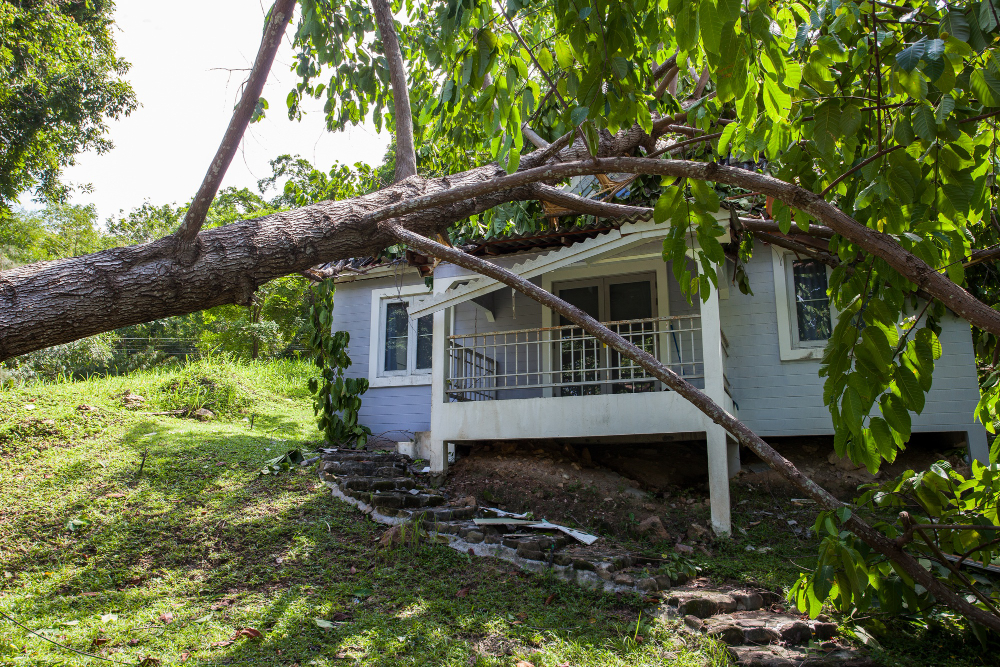
Understanding why trees fall is essential for any property owner in Ohio, where seasonal storms, saturated soils, and rapid weather changes create repeated stress on urban and rural trees alike. While a fallen tree often feels sudden, most failures are the result of long-developing structural weaknesses combined with environmental triggers that push the tree beyond its limits.
In this article, you will learn how storm conditions expose hidden tree weaknesses, which structural defects create the highest risk, what external stressors accelerate failure, and how proactive management reduces the likelihood of damage before storm season arrives.
Here's what you need to know.
- Why trees fail in conditions homeowners expect to be routine
- How storms expose weaknesses that have been developing for years
- Which structural problems quietly turn trees into high-risk hazards
- How to reduce the risk of trees falling before the next storm hits
Keep reading to understand what is actually happening inside a tree long before it falls, and what you can do about it.
Why trees fail in conditions homeowners expect to be routine
Most tree failures are not witnessed in slow motion. They happen during moments of routine weather that homeowners perceive as normal. A tree that has stood for decades may suddenly split, uproot, or shed large limbs during what appears to be a standard wind event.
Why moderate storms trigger failures that extreme weather never did
A common misconception is that trees only fall during hurricanes or severe storm events. In reality, many failures occur during moderate conditions because the tree was already structurally compromised before the storm arrived.
A tree does not need extreme weather to fail. It only needs conditions that exceed its reduced structural capacity. Several factors contribute to this dynamic:
- Trees enter the storm already weakened by years of internal decay or root stress
- Soil saturation from recent rain reduces anchoring strength before wind loads even begin
- Repeated stress from prior storms has degraded internal wood fiber over time
- Wind direction creates unexpected leverage points on an unbalanced canopy
- Even moderate gusts generate significant force against large canopy surface areas
This is why storm damaged trees in Ohio often show delayed failure patterns rather than collapsing immediately during the worst conditions.
How Ohio's seasonal weather creates cumulative stress on trees year after year
Ohio experiences a mix of seasonal weather patterns that place repeated mechanical stress on trees throughout the year, with no single season providing full recovery time.
Spring thunderstorms deliver high wind gusts and rapid soil saturation. Summer microbursts produce sudden wind shifts that hit canopies from unexpected angles.
Prolonged fall rainfall drives soil moisture to capacity before winter arrives. Ice accumulation and snow loading in winter add significant weight to already-stressed branch structures. Freeze-thaw cycles then weaken root zones by expanding and contracting soil around root systems repeatedly.
A tree may survive one of these cycles, then another, then several more, until a final event exceeds its remaining structural capacity. The storm that causes the failure is rarely the storm that caused the problem.
Why a full, green canopy is not the same thing as a stable tree
One of the most dangerous assumptions in tree risk assessment is equating visual appearance with structural integrity. A tree can carry a full canopy of healthy leaves, appear firmly rooted from the street, show no visible bark damage, and look balanced in silhouette while still being at significant risk of failure.
Internal issues such as decay, root damage, or weak branch unions are not visible from the outside. Trees often compensate for internal weakness by redistributing weight across remaining healthy tissue, which can mask structural problems until a storm removes any remaining margin. Understanding the signs a tree needs to be removed before an event occurs is far more useful than evaluating damage after the fact.
How storms expose weaknesses that have been developing underground and inside the trunk
Storms rarely create new structural problems in trees. Instead, they reveal weaknesses that have been developing silently over months or years. The storm is the test, not the cause.
Why wind direction and soil saturation matter more than wind speed alone
Wind speed is only one part of the failure equation. The direction and consistency of wind forces play a major role in how trees respond under load. Trees are especially vulnerable when wind hits the canopy from an unusual or previously unexposed direction, when gusts are inconsistent and shifting rather than steady, when long-duration winds apply constant lateral pressure, or when canopy structure is uneven and concentrates force on one side.
Soil saturation compounds all of these factors. When the ground is saturated, root systems lose anchoring strength, soil becomes unstable and shifts under lateral load, and trees become significantly more prone to uprooting rather than trunk breakage.
According to the U.S. Forest Service, saturated soil conditions are among the primary contributors to wind-induced tree uprooting, particularly in clay-heavy soils common across much of Ohio.
How rain-soaked soil undermines roots in ways that take hours, not seasons
Roots rely on soil density for structural resistance. When soil becomes overly saturated, it loses the friction properties that allow root systems to resist lateral movement. The consequences develop quickly.
Reduced friction between roots and surrounding soil means that even moderate wind loads produce movement that dry conditions would resist entirely. Soil displacement begins to occur around the root flare zone, a visible sign that the anchoring system is already failing.
Uprooting then becomes the dominant failure mode rather than trunk breakage, and because uprooting events affect a large surface area, the resulting damage to surrounding structures and landscapes is typically more extensive than a trunk split.
This is especially common in shallow-rooted tree species and in areas with clay-heavy or compacted soils, both of which are prevalent across Northeast Ohio. After a significant rain event, the window of elevated risk can last 24 to 72 hours, well beyond the storm itself.
What internal decay looks like from the outside and why it is so often missed
Internal decay is one of the most significant contributors to sudden tree failure, and it is frequently missed because its most dangerous stages develop inside wood that looks structurally intact from the surface.
Decay can originate from old pruning wounds that were never properly sealed, storm damage scars that created entry points for fungal growth, insect infestations that damaged vascular tissue, and root injuries from construction or soil compaction. T
he outer wood often remains intact while the interior progressively hollows or softens, creating a shell that cannot support structural loads under storm conditions. Trees with advanced internal decay may appear healthy right up to the moment of failure. A professional evaluation that includes sounding the trunk and examining fungal indicators at the base is the only reliable way to detect this condition before it causes damage.
Which structural problems quietly turn trees into high-risk hazards
Many trees that fail during storms already contain structural weaknesses that developed over years. These issues often go unnoticed without professional inspection because they do not change the tree's outward appearance until failure is imminent.
How to read trunk cracks, hollow sections, and fungal growth as failure warnings
Trunk defects are among the most serious tree structural failure signs, and several of them are detectable by a homeowner who knows what to look for.
What do vertical cracks along the trunk indicate? Vertical cracks often signal internal stress fractures that have propagated through the wood under repeated wind load. Even shallow surface cracks can reflect deeper splits that compromise the trunk's load-bearing capacity.
What does fungal growth at the base of a tree mean? Fungal bodies, including shelf fungi and mushrooms growing at or near the root flare, are almost always an indicator of active internal decay. The fungal structure visible on the surface is the fruiting body of an organism that has already colonized significant internal tissue.
Why does a hollow-sounding trunk matter? A trunk that produces a hollow sound when tapped has lost internal wood mass to decay. The outer shell may still appear solid, but the structural core that resists bending and torsion under wind load is compromised. Combined with seams or splits forming along trunk lines, these indicators warrant immediate professional evaluation.
Why weak branch unions create splitting hazards that pruning alone cannot fix
Branch attachment strength plays a direct role in overall tree stability, and weak unions are among the most common contributors to storm-related limb failure. Weak unions form when two branches grow too closely together and bark becomes embedded between them, a condition called included bark, when branch angles are too narrow to develop a strong collar attachment, or when rapid growth creates a size imbalance between the branch and its supporting structure.
These attachment points are prone to splitting under load from ice, wind, or heavy foliage weight. The failure often happens without any visible warning and can separate large limbs from the trunk in seconds. Tree cabling and bracing is a structural intervention specifically designed to support these weak unions and reduce splitting risk in mature trees where the attachment geometry cannot be corrected through pruning alone.
How gradual leaning signals root instability before full failure occurs
A leaning tree is not automatically dangerous, but a change in lean over time is one of the clearest early indicators of progressive root instability. When a tree's lean increases gradually, it typically signals that the root system is losing its ability to counter the tree's weight and the lateral forces applied by wind.
Progressive leaning can result from soil erosion removing support from one side of the root zone, root decay reducing the structural capacity of anchoring roots, construction impact that severed or compacted roots, or saturated soil conditions that allow the entire root plate to shift.
Soil heaving around the base of a leaning tree, visible as raised or cracked ground on the side opposite the lean, is a particularly urgent indicator that the root plate is already lifting. T
his condition often precedes full uprooting during the next significant storm event. If you are uncertain whether a leaning tree on your property represents a genuine risk, reviewing the dead or dying tree warning signs that professionals use provides a useful starting framework.
How to reduce the risk of trees falling before the next storm season hits
Preventing tree failure is far more cost-effective than responding after damage occurs. Proactive management consistently produces better outcomes than emergency response, both financially and in terms of property protection.
What a professional tree inspection actually covers and why timing matters
Professional tree inspections identify structural issues that are not visible to homeowners conducting a visual check from the ground. A thorough inspection assesses trunk and branch structural integrity, root system stability and anchoring condition, active signs of decay or disease progression, canopy balance and mechanical weight distribution, and environmental risk factors including proximity to structures and utility lines.
According to the U.S. Department of Agriculture, systematic risk assessment by trained arborists significantly reduces the incidence of unexpected tree failure in managed landscapes, particularly when inspections are conducted before and after severe weather seasons.
Scheduling an inspection in late winter or early spring, before foliage fills in and masks structural defects, provides the clearest evaluation window and the most time to act on findings before summer storm season begins.
When corrective pruning solves the problem and when removal is the only safe answer
Not all trees with structural issues require removal, and the decision between intervention and removal depends on the severity, location, and type of defect present.
Corrective pruning is typically appropriate when:
- Structural issues are localized to specific branches or one section of the canopy
- The overall trunk and root system remain stable and undamaged
- Canopy imbalance can be corrected without removing major structural limbs
- The tree's long-term health trajectory supports continued management
Removal becomes the safer option when:
- Structural failure risk is assessed as high or imminent by a certified arborist
- Root system compromise is extensive enough to affect overall anchoring
- Trunk decay has progressed beyond the point where the shell can bear storm loads
- The tree's location makes partial failure an unacceptable risk to structures or people
The line between these two outcomes is not always obvious, which is precisely why professional evaluation matters. A certified arborist's assessment of tree removal versus tree trimming is based on the specific condition of the tree, not a general preference for one approach over the other.
How strategic landscape planning reduces long-term storm exposure
Long-term fallen tree prevention begins well before a specific tree shows signs of distress. Thoughtful landscape planning reduces future risk at the property level and minimizes the likelihood of storm-related failures across the entire tree population on a site.
Best practices include:
- Planting new trees at distances from structures that account for mature canopy spread and root zone growth
- Selecting species appropriate for Northeast Ohio soil conditions, particularly in areas with clay-heavy or poorly drained soils
- Avoiding placement beneath or near overhead utility lines, where future pruning will create structural imbalance
- Considering prevailing wind exposure patterns when determining placement of large-canopy species
- Establishing a routine inspection and maintenance schedule that identifies emerging issues before they escalate
Spring tree care for Northeast Ohio homeowners covers the seasonal maintenance priorities that support long-term structural health across the most critical window of the Ohio weather calendar.
Conclusion
Understanding why trees fall means looking past the moment of failure and examining the long-term structural, environmental, and biological factors that created the conditions for it. Most failures are not sudden events. They are the result of years of hidden decay, root stress, canopy imbalance, and accumulated environmental pressure that a single storm finally exposed.
In Ohio, where seasonal weather cycles deliver repeated mechanical stress across every month of the year, trees face sustained challenges from wind, rain, ice, and soil saturation. The trees most likely to fail are rarely the ones that look most at risk. Internal decay, root instability, and weak branch unions can all develop invisibly while a tree continues to carry a full, healthy canopy.
Recognizing structural failure signs early, addressing weak tree risk factors before storm season, and scheduling professional inspections as a routine part of property maintenance are the most reliable strategies available to Ohio homeowners. The cost of prevention is consistently lower than the cost of emergency response, and the outcomes are far more predictable.
When you are ready to have your trees evaluated before the next weather event, Premier Tree provides certified arborist inspections, structural risk assessments, and full-service emergency tree removal throughout Cleveland and Northeast Ohio.
