


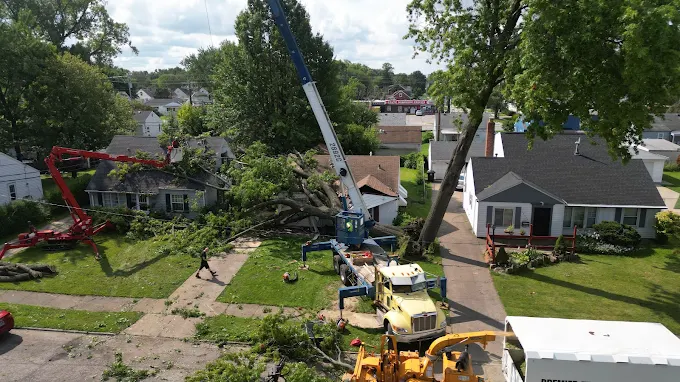
How August storms affect trees in Cuyahoga County, OH is not always obvious the morning after the rain stops. A tree can look mostly upright and still have cracked limbs, loosened roots, torn bark, or canopy stress that becomes more dangerous during the next round of wind.
August is a tough month for trees in Greater Cleveland because late-summer storms often arrive after weeks of heat, compacted soil, pest pressure, and heavy leaf growth. That means branches catch more wind, saturated soil can lose grip around roots, and old decay can show up suddenly as a split trunk or dropped limb.
For homeowners in Cleveland, Parma, Lakewood, Westlake, Strongsville, Euclid, and other Cuyahoga County communities, the safest response is a calm inspection from the ground first. If you see hanging limbs, a new lean, exposed roots, or damage near your home, driveway, sidewalk, or power line, treat it as a property risk until a professional can evaluate it.
Premier Tree Specialists provides certified tree care across Cuyahoga County, including storm cleanup, pruning, removal, stump grinding, and arborist consultations. If the storm leaves you unsure what the tree needs, start by identifying immediate hazards before cleanup begins.
In this article, you will learn about:
- Why August storms are hard on Cuyahoga County trees
- What storm damage can look like after the weather clears
- Which trees are most likely to fail during late-summer weather
- What to do after an August storm hits your property
Keep reading to know what matters, what can wait, and when a storm-damaged tree needs professional attention.
Why August storms are hard on Cuyahoga County trees
August storms can be intense because they often combine heat, humidity, heavy rain, and fast-moving wind. Trees are also carrying a full canopy, so the same gust that might pass through a bare winter crown can push hard against thousands of leaves in late summer.
The concern is not only whether a tree falls. August weather can weaken branch unions, open wounds that invite decay, and shift soil around major roots. Those changes may not become obvious until the next storm, the next pruning cycle, or the first heavy snow.
The risk is not theoretical in Northeast Ohio. During the August 6, 2024 severe weather event, NWS Cleveland documented five EF-1 tornadoes, more than 400,000 residents without power, and an eastern Cuyahoga County macroburst with estimated winds of 70 to 90 mph.
Severe wind can turn hidden weaknesses into visible failures
The National Weather Service defines a severe thunderstorm as one capable of producing wind gusts over 58 mph or hail at least 1 inch across. Wind at that level can break large branches, knock trees over, or cause structural damage within the crown.
That matters in Cuyahoga County because many residential trees stand close to houses, garages, fences, parked vehicles, sidewalks, and overhead service lines. A weak limb over a driveway is not just a landscape issue when wind speeds reach severe criteria.
Common wind-related failures after an August storm include:
- Broken limbs hanging in the canopy
- Splits where two large stems meet
- Fresh cracks along the trunk or major scaffold limbs
- Uprooted soil on one side of the tree
- Branches resting on roofs, gutters, sheds, or wires
These problems are especially important when they affect mature maples, oaks, elms, locusts, pines, and silver maples. Large trees can often be preserved, but only when the remaining structure is sound enough to justify pruning, support, or monitoring.
If several of these signs show up on the same tree, assume the damage is connected until an arborist proves otherwise. A broken limb, a new lean, and raised soil together point to a larger structural problem than a single snapped branch.
Heavy rain can loosen soil around roots
Cleveland's climate normals show that August averages 3.56 inches of precipitation and an average high of 82 degrees, according to the National Weather Service Cleveland climate normals. That mix of warm temperatures and rain can leave trees under real mechanical stress when thunderstorms arrive in clusters.
When soil is already wet, roots may not hold as firmly during strong gusts. Trees growing in shallow soil, compacted clay, low areas, or near hardscape can be more vulnerable because their roots have less usable space to anchor the tree.
After heavy rain, pay attention to the base of the tree, not only the branches above you. A tree that has shifted may show lifted turf, fresh soil cracks, a gap around the trunk flare, or roots pulling up on the windward side.
Late-summer canopies catch more force than homeowners expect
A full summer canopy acts like a sail. Leaves add surface area, and that surface area gives wind more to push against during a thunderstorm or microburst.
That is one reason crown structure matters so much. Proper pruning can reduce overextended limbs, weak attachments, and crowded interior growth, while topping or random cutting can create fast-growing sprouts that fail more easily later.
If you have wondered whether proper pruning would reduce storm risk, the answer depends on species, age, condition, growth rate, and whether the canopy has structural defects that catch wind.
What storm damage can look like after the weather clears
The first pass after a storm should be visual and cautious. Walk the property only when conditions are safe, stay away from downed wires, and look at the tree from several angles before moving branches or debris.
Storm damage does not always mean immediate removal. Some trees need corrective pruning, some need cabling or follow-up monitoring, and some are no longer safe enough to keep. The difference depends on the tree's structure, species, location, and the amount of living crown that remains.
Hanging limbs and cracked branches are urgent hazards
The most obvious hazards are limbs that are broken but still suspended in the canopy. These can shift without warning, especially when wind picks up again or cleanup activity moves the tree.
Cracked limbs can be harder to spot. Look for fresh pale wood, torn bark, branches hanging lower than normal, or leaves wilting on only one section of the canopy.
A storm-damaged tree may need immediate attention when you notice:
- A large limb hanging over a roof, driveway, sidewalk, or play area
- A branch lodged against another branch
- Fresh bark tearing at a branch union
- A cracked limb attached to the trunk
- Broken branches near electrical service lines
Do not pull or cut large hanging limbs from the ground. Storm-loaded branches can be under tension, and the release point is not always where a homeowner expects it to be.
If the limb is near a roofline, sidewalk, or driveway, keep the area clear until the branch is secured or removed. Even a branch that looks stuck in place can drop when another limb shifts above it.
Root movement is easy to miss from the street
Root damage can be more serious than branch damage because it affects the whole tree. A tree that has partly lifted out of the ground may stay upright for the moment, then fail during the next storm or under its own shifted weight.
Walk far enough back to compare the trunk angle with nearby vertical lines, such as a fence post or house corner. A new lean after a storm is different from a long-standing lean that the tree has grown around for years.
If you see raised soil, exposed roots, or cracking around the root zone, avoid compacting the area with vehicles or equipment. A professional inspection can determine whether the root plate is stable, compromised, or beyond practical repair.
Not every broken tree is a removal case
Some storm damage looks dramatic but can be corrected with proper pruning. Smaller broken side branches, minor crown damage, and cleanable wounds may allow the tree to recover if the trunk and major limbs are still stable.
Other damage changes the risk picture immediately. Iowa State University Extension notes that large trees that have lost 50 percent or more of their canopy, split trunks, extensive trunk damage, or partial uprooting are often removal candidates, according to its guidance on whether a damaged tree can be saved.
This is where the recommendation becomes practical, not cosmetic. If the tree can be made safe and healthy, pruning may be enough. If the structure is failing, removal may be the safer long-term option.
Which trees are most likely to fail during late-summer weather
Any tree can fail in extreme wind, especially if the soil is saturated or the tree has hidden decay. Still, some trees and locations deserve more attention before and after August storms.
The highest-risk trees are usually the ones with existing structural defects. Homeowners often see the fallen limb after the storm, but an arborist looks for the earlier clues that explain why that limb failed.
Trees with decay, cavities, or deadwood have less margin
Deadwood is brittle, and decayed wood has less strength than healthy wood. During a late-summer storm, those weak spots can break before the rest of the canopy shows obvious distress.
Look for dead branches without leaves, mushrooms or fungal growth near the base, cavities, peeling bark, carpenter ant activity, or large old pruning wounds. These signs do not automatically mean the tree must come down, but they do mean the tree deserves a closer look.
If you are unsure whether a tree is declining, canopy thinning, bark loss, fungal growth, brittle limbs, and other clues can become more dangerous during storm season.
Co-dominant stems and tight branch unions can split
Co-dominant stems happen when two large stems grow from the same area of the trunk. If the union is tight, bark can become included between the stems instead of forming strong wood-to-wood attachment.
In calm weather, that union may look normal. In August wind, the two stems can move in different directions, opening a crack down the trunk or dropping one side of the canopy.
Some trees with weak unions can be managed with structural pruning, reduction cuts, or support systems. In the right situation, reducing movement may help preserve a valuable tree, but the work should be designed by someone who understands tree structure.
Trees near homes, pavement, and utilities carry more consequence
A tree in the back corner of a large lot is a different risk than a tree over a bedroom, driveway, business entrance, or service drop. The likelihood of failure matters, but so does what the tree could hit.
Urban and suburban trees also deal with stresses that forest trees do not. Soil compaction, limited rooting space, mower wounds, driveway cuts, grade changes, and previous construction can all weaken the root system over time.
When a tree is growing near a foundation, sidewalk, sewer line, or driveway, storm risk and root behavior should be evaluated together. Roots, soil, hardscape, and nearby structures all shape the risk picture.
What to do after an August storm hits your property
After a storm, your goal is to reduce immediate danger without creating new hazards. That means you should document the damage, keep people away from unstable areas, and call for help when a tree is touching a structure, blocking access, or showing signs of structural failure.
Do not rush into chainsaw work because a limb looks manageable from the ground. Storm-damaged trees can twist, roll, spring back, or shift weight as cuts are made.
Start with a safe ground-level assessment
Begin from inside or from a safe distance if a tree is on the house, touching wires, or leaning toward an occupied area. Use photos and notes instead of moving heavy debris right away.
Once it is safe to walk outside, check the tree, the surrounding targets, and the ground around the trunk. The order matters because a fallen branch may be only one part of a larger failure.
Use this quick sequence:
- Look for downed or sagging wires and stay away from them.
- Check whether limbs are resting on the roof, gutters, vehicles, fences, or sheds.
- Look up for broken branches still hanging in the canopy.
- Step back and compare the tree's lean from multiple angles.
- Inspect the root zone for lifted soil, cracks, or exposed roots.
- Photograph damage before cleanup if insurance may be involved.
If access is blocked or a tree has struck a structure, call for professional help before moving major pieces. A tree on a house, blocking a driveway, leaning after the storm, or creating an immediate safety hazard usually needs urgent attention.
Once immediate safety is handled, take a slower second look before final cleanup. Photos, trunk-angle notes, and close-ups of exposed roots can help an arborist understand what changed during the storm.
Call an arborist when the structure is uncertain
An arborist can evaluate more than the broken limb. The inspection should consider the tree's species, trunk condition, canopy balance, root stability, target area, and history of previous pruning or storm damage.
That level of judgment matters because some damage is manageable, while some creates repeat failure risk. A branch can be removed cleanly, but a split trunk, loosened root plate, or major canopy loss changes the future of the tree.
If the tree is not an emergency but you need a clear recommendation, an arborist can help you decide whether pruning, support, monitoring, plant health care, or removal makes the most sense.
Plan cleanup around permits, timing, and future risk
Storm cleanup is not only about removing what fell. It is also a chance to decide whether the remaining tree is safe, whether the stump should be addressed, and whether nearby trees need preventive pruning before the next storm.
In Cleveland and nearby communities, local requirements can matter when a tree is protected, located in a right-of-way, or connected to a larger construction or property project. If removal is approved or clearly necessary, the timing and complexity will depend on access, tree size, condition, nearby targets, and cleanup needs.
Conclusion
August storms can expose tree problems that were easy to overlook earlier in the summer. Heavy rain, full canopies, saturated soil, and sudden wind can turn small defects into cracked limbs, uprooted roots, or hazardous trees near homes and driveways.
The safest approach is to inspect from the ground, keep people away from unstable areas, and look for changes that were not there before the storm. Hanging limbs, a new lean, split trunks, raised soil, and major canopy loss all deserve professional attention.
Some trees can be restored with careful pruning or support, while others need to be removed before the next storm makes the damage worse. A trained arborist can help you make that call with the tree's health, your property, and long-term safety in mind.
If an August storm damaged a tree on your Cuyahoga County property, Premier Tree Specialists can inspect the damage, explain your options, and provide a free quote for safe tree service.
