


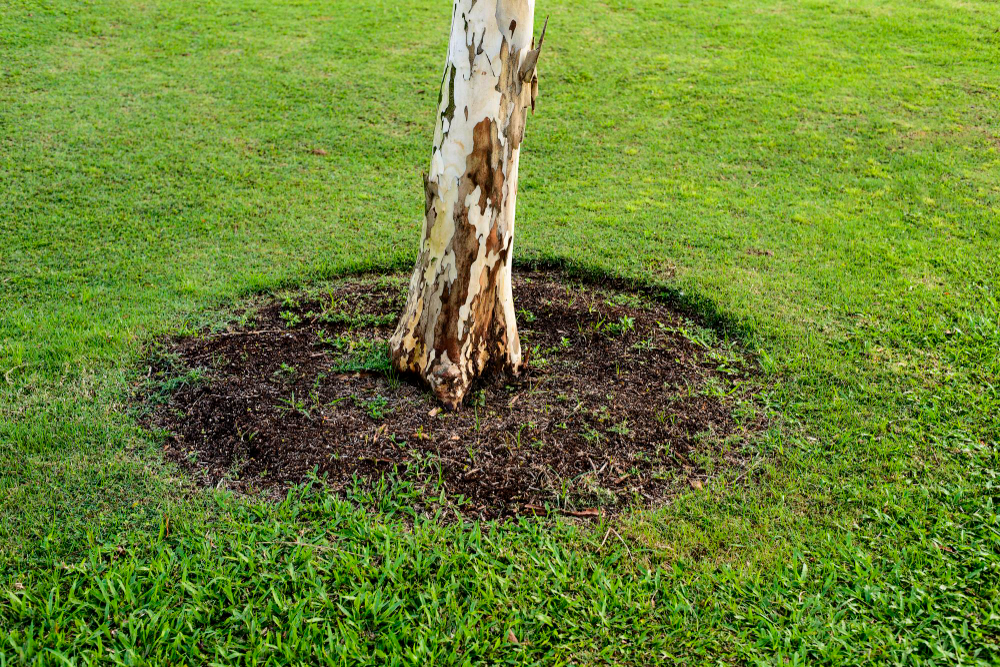
Mulching is one of the simplest and most beneficial things property owners can do for their trees. A properly installed mulch ring conserves moisture, regulates soil temperature, suppresses weeds, reduces competition from turfgrass, and improves the soil biology that tree roots depend on.
Yet despite its benefits, mulching is also one of the most consistently misunderstood aspects of tree care in Ohio landscapes.
Many homeowners assume that as long as mulch is present, their trees are protected. In reality, how mulch is applied matters just as much as the mulch itself. The wrong technique — particularly piling mulch high against the trunk — can damage roots, encourage disease, attract pests, and contribute to gradual tree decline.
Here's what you'll learn:
- Why over-mulching often looks professional but quietly causes damage
- What proper mulch placement actually looks like around a healthy tree
- The mulch volcano mistake and what it does to the trunk and root system
- How to choose the right mulch material for Ohio landscapes
- When mulching alone isn't enough and professional evaluation is needed
Keep reading to understand the difference between mulching that supports tree health and mulching that slowly undermines it.
The moment you realize your trees are struggling and the mulch bed might be part of the problem
When trees begin showing signs of stress, most homeowners look for obvious causes — drought, disease, storm damage, or insects. What often goes unnoticed is that the mulch surrounding the tree may be contributing to the problem.
A tree can appear healthy for years while improper mulching gradually creates unfavorable conditions around the root flare and lower trunk. Because these issues develop slowly, the connection between mulch application and tree health is easy to miss.
Why over-mulching often looks neat but quietly damages tree health
Many landscaping trends prioritize appearance over plant health. Deep mulch beds and raised mulch mounds can create a polished look that appears well-maintained and professional.
Unfortunately, excessive mulch creates problems below the surface that are invisible until symptoms become severe. According to the USDA, while mulch provides genuine benefits when applied correctly, spreading too much can be damaging to trees and plants — and volcano mulching in particular creates trunk rot risk that is entirely avoidable.
When mulch is applied too deeply, it can:
- Restrict oxygen movement into the soil around roots
- Hold excessive moisture against bark and root tissue
- Create favorable conditions for fungal and bacterial growth
- Alter normal root development patterns
- Increase bark decay risk over time
Trees require a balance of air, water, and nutrients within the root zone. Excessive mulch disrupts this balance by creating persistently wet conditions while reducing the oxygen availability that healthy roots depend on.
How Ohio weather makes improper mulch buildup even more harmful
Ohio's climate amplifies the effects of poor mulching practices. The state's heavy spring rainfall, humid summers, periodic droughts, and repeated winter freeze-thaw cycles all interact with mulch conditions in ways that can worsen moisture-related problems.
During wet spring months, deep mulch traps water around the base of the tree for extended periods — promoting fungal activity and bark deterioration. In winter, thick mulch piled against the trunk creates sheltered environments that attract rodents seeking protection from cold temperatures. These animals may chew bark and damage the tree's vascular system.
Ohio's moisture fluctuations make proper mulch management especially important for maintaining long-term tree health.
The misconception that more mulch always means better protection
There is a persistent belief that adding more mulch automatically improves tree protection. This is not accurate. Mulch offers clear benefits up to a point — and beyond that point, additional material becomes counterproductive.
The Texas A&M Forest Service confirms that organic mulch encourages beneficial soil microorganisms and improves soil quality over time — but also warns that mulch applied incorrectly can prevent water from reaching the soil and actively promote the growth of harmful fungi and bacteria around the root zone.
The goal is not maximum mulch volume. It is creating a stable environment that supports healthy root function without introducing moisture or oxygen problems.
What proper mulch placement actually looks like around a healthy tree
Correct mulching involves more than spreading wood chips around the base of a tree. Placement, depth, and coverage area all determine whether the mulch bed helps or harms the tree over time.
The correct mulch ring size compared to trunk diameter
One of the most common mistakes is creating a mulch ring that is too small. Many mulch beds extend only a few inches beyond the trunk, covering a fraction of the actual root zone.
Tree roots typically extend well beyond the canopy drip line and occupy a much larger area than most people realize. While covering the entire root zone is rarely practical in residential landscapes, increasing the mulch area provides meaningful benefits.
General guidelines include:
- Larger mulch rings are always better than smaller ones
- The ring should extend as far from the trunk as practical — ideally to the drip line
- Newly planted trees benefit especially from wide mulch coverage
- Mature trees benefit from expanded root zone protection that reduces turfgrass competition
According to USDA Forest Service research cited by the University of Missouri Extension, trees mulched with organic materials grow 26–29% faster than those in bare ground — and nearly double the growth rate of trees competing with grass or weedy vegetation. A wider mulch ring directly translates to less competition and more available soil moisture for the root system.
Why mulch should never touch the tree trunk directly
This is the single most important principle of proper mulching. The area where the trunk transitions into the root system — called the root flare — should always remain visible and exposed to air.
When mulch contacts the trunk directly, a predictable chain of problems begins:
- Bark remains excessively moist and cannot dry out between rain events
- Decay organisms become more active in the consistently wet environment
- Insects and pests find easy access to compromised bark tissue
- The root flare becomes buried, cutting off normal air exchange
- Trunk tissue weakens progressively from the outside inward
A properly mulched tree looks like a donut from above — a ring of mulch surrounding the tree, with several inches of open space between the mulch and the trunk. That gap is not cosmetic. It is essential for maintaining healthy bark conditions and preventing the cascade of problems that begins when moisture is trapped against the trunk.
Ideal mulch depth and how it supports soil health
Mulch depth is a critical and frequently mismanaged variable. For most trees, arborists recommend maintaining a layer approximately two to four inches deep. The USDA Forest Service confirms this range as the standard recommendation, noting that mulch should not exceed three to four inches in depth.
This range provides the core benefits of mulching — moisture conservation, temperature regulation, weed suppression, and organic matter contribution — without creating the excessive moisture retention and oxygen restriction that deeper applications cause.
It is also important to check existing mulch before adding more. Many homeowners add a new layer each season without removing or assessing what is already there. Over several years, this accumulation can push depths well beyond four inches without anyone realizing it. Fluffing compacted mulch and removing excess before refreshing the bed is a simple step that prevents progressive over-application.
The mulch volcano mistake that slowly weakens trees from the inside out
No landscaping practice is more widely criticized by arborists than the mulch volcano — and yet it remains one of the most common sights in Ohio residential and commercial landscapes. The damage it causes develops slowly, which is exactly why the problem persists.
How piled mulch traps moisture against bark and causes decay
Tree bark is designed to remain relatively dry and exposed to air. It protects the living tissue beneath from dehydration, oxidation, and direct access by pests and pathogens. When mulch is piled against the trunk, that protection is undermined.
Moisture becomes trapped against bark tissues for extended periods, creating ideal conditions for fungal growth, bacterial activity, and progressive bark deterioration. As decay progresses, the tree's protective outer layer becomes compromised. Damage to bark tissues interferes with the transport of water and nutrients throughout the tree — a process that occurs entirely out of sight until symptoms appear in the canopy.
In severe cases, trunk decay contributes to structural weakness and increases the risk of failure. Ohio State University's Buckeye Yard and Garden Line confirms that mulch piled against the trunk elevates moisture content in the bark, making it susceptible to decay in a process directly analogous to severe skin damage — the protective barrier breaks down, and what lies beneath becomes exposed and vulnerable.
The way roots start growing into mulch instead of soil
A lesser-known but serious consequence of mulch volcanoes is the development of abnormal root growth. When mulch remains excessively moist, roots may begin growing upward into the mulch layer rather than downward into stable soil.
These roots develop because conditions inside the moist mulch appear more favorable than the compacted soil below. But this comes with serious long-term consequences:
- Mulch-layer roots lack the stability of soil-anchored roots
- They become exposed and vulnerable when mulch dries out or decomposes
- They are highly susceptible to drought stress
- Most critically, they can develop into girdling roots — roots that grow in a circle and wrap around the trunk base
Girdling roots are particularly dangerous because they gradually constrict the trunk's vascular tissue, restricting the flow of water and nutrients upward to the canopy. This condition can progress for years before homeowners notice symptoms, and by the time dieback appears, the constriction may already be severe.
Early warning signs your tree is already affected by improper mulching
Because mulch-related stress resembles other health issues, it is often misattributed. Common warning signs that mulch may be contributing to decline include:
- Sparse or thinning canopy growth
- Premature fall color development
- Leaf discoloration or undersized leaves
- Reduced annual growth compared to previous years
- Branch dieback beginning at outer tips
- Visible decay, darkening, or soft tissue near the trunk base
- Adventitious roots growing upward into the mulch ring
- Fungal fruiting bodies appearing around the root flare
If you are seeing these symptoms and a mulch volcano is present, correcting the mulch application is the first step — but professional evaluation is recommended to assess whether bark or vascular damage has already occurred. In some cases, arborist root collar excavation is needed to safely expose and assess the root flare after long-term burial.
Choosing the right mulch material for long-term tree health in Ohio landscapes
Not all mulch materials perform the same way. The type of mulch selected influences moisture retention, decomposition rates, soil biology, and the overall growing environment for tree roots.
Organic vs. inorganic mulch and why it matters for soil biology
Mulch materials generally fall into two categories, and for trees the distinction matters considerably.
Organic mulches — hardwood bark, wood chips, shredded bark, leaf mulch, and pine bark — provide benefits that extend well beyond surface moisture retention. As they decompose, they contribute organic matter, improve microbial activity, and gradually enhance soil structure. They mirror the natural forest floor environment that tree root systems evolved within.
Inorganic mulches — stone, gravel, rubber, and decorative rock — offer aesthetic appeal and weed suppression but contribute nothing to soil biology. Over time, some inorganic materials can actually raise soil temperature and alter drainage patterns in ways that stress tree roots.
For tree health in Ohio landscapes, organic mulches are consistently the better choice. The USDA confirms that organic mulch increases microbial activity in the soil, which improves nutrient cycling and long-term soil quality in ways that inorganic materials cannot replicate.
How hardwood mulch breaks down differently over time
Hardwood mulch is among the most popular choices for Ohio landscapes. As it decomposes, it gradually enriches the soil with organic matter and nutrients — improving texture, moisture regulation, and microbial activity over multiple seasons.
Because hardwood mulch naturally breaks down, periodic replenishment is necessary. The key is to add new mulch carefully — assessing current depth first and adding only what is needed to restore the two-to-four-inch target range. Never simply pile new mulch on top of what is already there without checking the existing depth.
Hardwood chip sizes also matter. Finely shredded mulch breaks down faster and can mat together in ways that reduce air and water penetration. Coarser chips tend to maintain better structure and air movement through the mulch layer over time.
When mulch type can influence pest and disease risk
The mulch material selected can influence the environment around the tree in ways that affect pest and disease pressure. Poor-quality mulch may contain disease organisms or weed seeds. Excessively wet mulch encourages fungal growth. Thick mulch layers placed close to the home's foundation can attract termites or rodents.
These risks are manageable. High-quality mulch from reputable suppliers presents minimal pest risk when applied correctly and kept away from structure contact. Proper installation — correct depth, proper gap from the trunk, adequate ring width — remains more important than the specific variety in most situations.
When mulching is not enough and a tree needs professional evaluation
Mulching is a valuable component of tree care, but it is not a cure for all tree health problems. Some issues originate deeper within the root zone, soil profile, or vascular system and require professional diagnosis that mulch cannot address.
Signs of root stress that mulch alone cannot fix
Root problems often develop underground where they are difficult to detect, and their symptoms can look identical to drought stress or disease. Warning signs that may indicate deeper root problems include a thinning canopy, chronically small leaves, delayed leaf emergence in spring, branch dieback that progresses from tips inward, and reduced annual growth over multiple seasons.
Potential underlying causes — root damage from construction, root disease, girdling roots, poor drainage, or deep soil compaction — require evaluation beyond what surface mulch management can address. Correcting the mulch is often the right first step, but if symptoms persist after proper mulch installation, a certified arborist inspection is the appropriate next move.
When soil compaction requires deeper arborist intervention
Soil compaction is one of the most common problems affecting urban and suburban trees in Ohio. Compacted soils restrict oxygen availability, water infiltration, root growth, and nutrient movement — creating conditions that gradually weaken trees even when surface care appears adequate.
While mulch helps prevent future compaction by cushioning the soil surface, severely compacted soils often require specialized treatments that reach beneath the mulch layer:
- Soil aeration to restore pore space and oxygen movement
- Vertical mulching to introduce organic matter deep into the root zone
- Targeted soil amendments to improve structure and drainage
- Root zone rehabilitation to address compaction damage from construction or heavy traffic
These services address conditions that exist well below the surface — conditions that no amount of fresh mulch can reach or correct.
Why recurring decline signals a bigger plant health issue
When a tree continues declining despite proper watering, mulching, and maintenance, a larger underlying issue is likely present. Recurring symptoms over multiple growing seasons — dieback, thinning canopy, persistent discoloration — suggest the need for a comprehensive Plant Health Care assessment.
Certified arborists can evaluate biological, environmental, and structural factors simultaneously to identify what is actually driving the decline and develop a targeted treatment strategy. In some cases, what appears to be a mulching problem is actually an early indicator of tree disease, root disorder, or structural decline that requires a different response entirely.
If the tree has progressed beyond what corrective care can address, an arborist can also help determine whether removal is the right next step — and what tree removal costs to expect.
Conclusion
Mulching is one of the most effective and affordable ways to support tree health — but only when applied correctly. A wide mulch ring, two-to-four-inch depth, exposed root flare, and quality organic material provide the greatest benefits while minimizing risk.
Common mistakes like over-mulching, piling mulch against the trunk, and creating mulch volcanoes can cause serious long-term damage. These practices lead to bark decay, abnormal root development, girdling, and gradual decline that may go unnoticed until the damage is already advanced.
For Ohio property owners, understanding the basics of proper mulching is an important part of protecting a landscape investment. It is also important to recognize when mulch alone is not enough — when persistent decline, root problems, soil compaction, or disease require professional evaluation and treatment.
At Premier Trees LLC, we help homeowners and property managers throughout Cleveland and Northeast Ohio protect their trees through expert arborist services, plant health care programs, tree pruning, and professional tree assessments. Contact our team if you are concerned about tree health, improper mulching, or signs of decline.
