


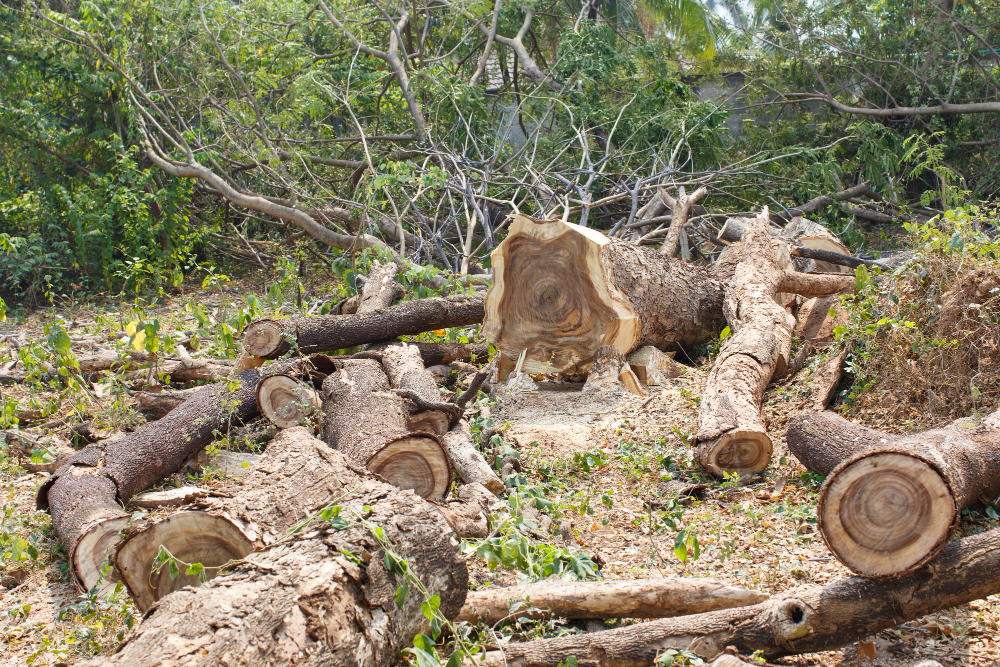
How long tree removal takes in Cleveland depends on a handful of factors that most homeowners do not think about until the crew is already on site. A small ornamental tree in an open backyard can come down in under an hour. A 70-foot oak wedged between a house, a fence, and a power line can take an entire day with a full crew, rigging equipment, and a careful plan for every cut. Most residential jobs in Northeast Ohio fall somewhere between those extremes, typically finishing within a few hours to a full day.
The size of the tree is the most obvious variable, but it is far from the only one. Location, access, the condition of the wood, what is underneath and around the tree, and whether stump grinding is included all shape the timeline. Understanding these factors before the crew arrives helps you plan your day, set realistic expectations, and avoid the frustration of a job that takes longer than you assumed.
This article walks through the full service-day experience for tree removal in Cleveland and Northeast Ohio, from what determines the timeline to what actually happens on site, how to prepare your property, and what comes after the tree is down.
In this article, you will learn about:
- The factors that determine how long your specific tree removal will take
- What happens during each phase of a professional tree removal
- How to prepare your property to keep the job on schedule
- What to expect after the tree is down, including stump grinding and site cleanup
Keep reading to know exactly what service day looks like so there are no surprises when the trucks pull up.
The factors that determine how long your specific tree removal will take
Every tree removal job is unique, and the timeline for yours depends on a combination of physical characteristics, site conditions, and logistical details that an experienced crew evaluates before the first cut. The estimate your arborist provides is based on reading all of these factors together, not just measuring the trunk.
Understanding what drives the timeline also helps you understand the pricing. A four-hour, three-person job with a bucket truck costs more than a one-hour, two-person job with hand tools, and the reasons are directly tied to what the tree and the site demand.
Tree size, species, and wood density
Size is the starting point for any timeline estimate, and it correlates roughly with the amount of cutting, rigging, chipping, and hauling the job requires. General ranges for residential tree removal in Northeast Ohio with an experienced crew of three to five people:
- Small trees under 30 feet, such as ornamental crabapples, redbuds, or dogwoods: 30 minutes to 2 hours
- Medium trees between 30 and 60 feet, such as mature maples, birches, or smaller oaks: 2 to 4 hours
- Large trees over 60 feet, such as full-grown oaks, tuliptrees, or sycamores: 4 to 8 hours or a full day depending on complexity
Species matters beyond height because wood density directly affects cutting speed. Hardwoods like oak, hickory, and hard maple take longer to cut through than softwoods like pine or spruce. Dense wood also produces heavier sections that require more careful rigging and more time to process through the chipper.
The canopy spread is another factor that size alone does not capture. A 50-foot tree with a 40-foot canopy spread generates significantly more branch material than a 50-foot tree with a narrow, columnar form. That material has to be cut, lowered, dragged, chipped, and hauled, all of which adds time.
Proximity to structures, utilities, and property lines
A tree standing in the middle of an open yard with clearance in every direction can often be felled in one piece, which is fast. A tree of the same size growing eight feet from the house, overhanging the roof, with a fence on one side and a neighbor's driveway on the other, has to come down in sections, with every piece rigged, controlled, and lowered to a specific landing zone.
Situations that add significant time to a removal in Cleveland neighborhoods:
- Branches over the roofline or gutters that must be cut and roped down rather than dropped
- Root systems near foundations, retaining walls, or underground utilities that require careful excavation during stump removal
- Overhead power lines that require coordination with the utility company or the use of hot-line rated equipment and trained operators
- Adjacent trees that limit drop zones and force the crew to work in tighter windows
- Steep slopes, poor drainage, or soft ground that complicates equipment positioning and footing
Many residential properties in Cleveland's older neighborhoods, inner-ring suburbs like Lakewood, Cleveland Heights, and Shaker Heights, and the denser developments across Summit and Lake counties present multiple access constraints on a single job. These are the situations where the difference between a qualified crew and an unqualified one shows up most clearly, both in safety and in how efficiently the work gets done.
Tree condition and structural unpredictability
A healthy tree with solid wood and intact structure behaves predictably when cut. A dead or decaying tree does not. Internal decay, hollow trunks, compromised root plates, and hanging deadwood all make a tree less predictable during removal, which means the crew has to slow down, reassess at each stage, and use additional rigging and control measures to keep the job safe.
Dead ash trees are the most common example in Northeast Ohio right now. Emerald ash borer has killed millions of ash trees across the state, and the wood becomes brittle quickly after the tree dies. A dead ash that looks like it might be a simple removal can snap unexpectedly during cutting, sending large sections in directions the crew did not plan for. This is why dead ash removal almost always takes longer and costs more than removing a healthy tree of the same size, and why it should only be handled by a professional crew with the experience and equipment to manage unpredictable wood.
Storm-damaged trees present a similar challenge. A tree that is partially uprooted, leaning against a structure, or tangled in another tree's canopy after a storm requires a different approach than a standing tree, and the additional complexity extends the timeline. Emergency removals after major weather events typically take longer than planned removals of the same tree in stable condition.
What happens during each phase of a professional tree removal
Knowing what the crew is actually doing at each stage of the job helps you understand why the timeline is what it is and why certain phases take longer than others. A professional tree removal is not just someone cutting a tree down. It is a structured sequence of steps, each with its own safety considerations and time requirements.
Most residential tree removals in Cleveland follow a consistent workflow, though the specific techniques vary based on the tree and the site.
Arrival, setup, and safety perimeter
The crew typically arrives in the morning, often between 7:30 and 9:00 AM depending on the company and the season. The first 15 to 30 minutes are spent on setup: unloading equipment, positioning the chipper and vehicles, laying down ground protection if needed, and establishing a safety perimeter around the work zone.
The crew lead or arborist does a final walk-through of the tree and the site before any cutting begins. This confirms the plan discussed during the estimate, identifies anything that may have changed since the initial assessment (new storm damage, a bird nest, a neighbor's car parked in the drop zone), and communicates the cutting sequence and roles to every crew member.
On properties with tight access, this setup phase may include:
- Coning off sections of the street or driveway for the chipper truck
- Setting up a rigging system with ropes and pulleys to control where cut sections land
- Positioning a bucket truck or aerial lift if the tree requires above-ground access
- Coordinating with a neighbor if equipment needs to stage on an adjacent property
Limb removal and canopy reduction
The active cutting usually begins with the outer limbs. The climber or bucket operator works from the outside of the canopy inward, removing branches in manageable sections and either lowering them on ropes or dropping them into the established drop zone where ground crew members drag them to the chipper.
This phase typically takes the longest portion of the total job time because the canopy contains the greatest volume of material. A mature maple or oak with a full canopy spread can produce an enormous amount of branch material that all has to be processed through the chipper, which operates continuously but can only handle so much volume per minute.
On trees near structures, this phase requires the most precision. Every cut is deliberate, and every piece is lowered in a controlled manner rather than dropped freely. The crew is constantly communicating, with the climber calling down to the ground crew before every cut and the ground crew confirming clear zones.
Trunk sectioning and final felling
Once the limbs are removed, the trunk is sectioned from the top down. The climber makes a series of cuts, each removing a log section that is either lowered on a rigging line or dropped to the ground depending on what is below. Larger trunks may require multiple cuts per section, and the heavier the wood, the more carefully each piece needs to be controlled.
The final section, the base of the trunk, is cut as close to ground level as possible. This is the simplest cut in the sequence but also the one that leaves the stump, which is addressed separately if stump grinding is part of the scope.
The logs are either chipped on site, loaded onto a truck for hauling, or left for the homeowner if they want the firewood. Many companies in Northeast Ohio offer the option of leaving the wood cut to firewood length, which reduces hauling time but requires the homeowner to split and stack it.
Cleanup, debris removal, and site restoration
Cleanup is often the most underestimated phase in terms of time. A large tree can generate an enormous volume of chips, sawdust, small branches, and leaf debris that covers a wide area. A thorough cleanup includes raking the entire work area, removing chips and sawdust from lawns, driveways, and beds, blowing debris off hardscaping, and leaving the site in a condition that looks like a professional crew was there, not a storm.
Good companies treat cleanup as a non-negotiable standard, not an add-on. The site should look clean enough that a homeowner returning from work would not have to do any follow-up work themselves.
If stump grinding is included, it may happen the same day or be scheduled as a separate visit depending on the equipment and the workload. Grinding a medium stump typically adds 30 to 60 minutes. Large stumps with extensive root flare can take longer. The grinding produces a pile of wood chips mixed with soil that fills the hole left by the stump, and many homeowners backfill with topsoil and seed the area afterward.
How to prepare your property to keep the job on schedule
The crew handles the tree work, but there are a few things you can do before they arrive that prevent delays, protect your property, and make the entire process smoother. A well-prepared site saves time for everyone.
Clearing the work zone and access path
The crew needs a clear path from the street to the tree, and they need open space around the tree for equipment, drop zones, and foot traffic. Anything in the way adds time because the crew either has to work around it or move it themselves before the job starts.
Before the crew arrives:
- Move vehicles out of the driveway and off the street in front of the property to make room for the chipper truck, which is typically 20 to 30 feet long, plus the crew truck and any additional equipment trailers
- Clear patio furniture, grills, planters, hoses, toys, and lawn decorations from the area around the tree and along the path between the tree and the street
- Open any gates the crew will need to pass through with equipment, and confirm the gates are wide enough for the gear. If a fence section needs to be removed temporarily, discuss this with the company during the estimate phase.
- Mark or flag any underground sprinkler lines, invisible dog fences, landscape lighting wires, or other buried features that the crew might not see. Stump grinders and heavy foot traffic can damage these if their locations are not communicated in advance.
Communicating with neighbors and managing expectations
Tree removal in a residential neighborhood is loud and visible. The chipper runs continuously during the cutting phases, producing a sustained noise level comparable to a lawnmower or leaf blower. Crews use chainsaws at various points. Large sections hitting the ground create impacts that can be startling if you are not expecting them.
A quick heads-up to your immediate neighbors the day before the job is a courtesy that prevents complaints and makes the crew's day easier. Let them know approximately when the work will start, that it may involve equipment in the street, and that the crew will clean up fully before leaving.
If the tree overhangs a neighbor's property or if equipment needs to stage on the public right-of-way, the tree service company should handle any necessary notifications or permit requirements as part of the job. Ask during the estimate whether any permits are needed for your specific location in Cleveland or your suburb.
Knowing what to do (and not do) while the crew is working
You do not need to be home for the entire job, but being present at the start is helpful. The crew lead will confirm the scope, show you the planned cutting sequence, and ask about any last-minute concerns. After that, the best thing you can do is stay out of the work zone and let the crew operate without interruption.
A few practical points for service day:
- Keep pets indoors or in a fenced area well away from the work zone for the duration of the job. The combination of falling debris, loud equipment, and heavy foot traffic is dangerous for animals.
- Keep children inside and away from windows facing the work area. Falling wood, flying chips, and swinging ropes create hazards that an active work zone is not designed to accommodate.
- Avoid approaching the crew during active cutting to ask questions. Wait for a natural pause or catch the crew lead during a break. Interrupting someone mid-cut or mid-rig creates a safety risk for everyone.
What to expect after the tree is down
The tree coming down is the most dramatic part of service day, but it is not the last step. What happens after the tree is removed determines whether the project feels complete or leaves you with follow-up work.
Stump grinding and what it leaves behind
If stump grinding is part of your service agreement, it may happen immediately after the tree is removed or on a separate visit within a few days. The grinder uses a rotating carbide-tipped wheel to chew the stump and major surface roots down to roughly six to twelve inches below grade, depending on what the area will be used for.
The process generates a pile of wood chips mixed with soil that is typically two to three times the volume of the original stump. Most companies spread the chips back into the hole as fill, but you will likely need to add topsoil on top if you plan to seed the area for lawn. A stump-ground area settles over the following months as the remaining root material below the grinding depth decomposes, so plan to add a second round of topsoil and seed after settling occurs.
If stump grinding is not included, the stump will remain at roughly six inches above grade. Untreated stumps can attract termites and carpenter ants, produce sucker growth from the root system, and create a tripping hazard. Addressing the stump at the time of removal is almost always more cost-effective than scheduling a separate visit later.
Assessing the surrounding trees after a removal
Removing a tree changes the conditions for every tree around it. Neighboring trees that were partially shaded by the removed tree's canopy are now exposed to more sun, wind, and temperature extremes than they were adapted to. This can cause temporary stress, sunscald on previously shaded bark, and shifts in growth patterns.
If the removed tree was part of a group or a canopy that provided mutual wind protection, the remaining trees may need a structural pruning assessment to ensure they can handle the increased wind loading on their own. This is especially relevant after removing a large tree from a tight group where the remaining trees developed lean or one-sided canopies in response to competition.
An arborist consultation after a significant removal can identify these risks early and recommend any corrective pruning or cabling needed to protect the trees that remain.
Replanting and restoring the landscape
Once the stump is ground and the site has settled, the area is ready for replanting or landscape restoration. This is an opportunity to choose a species that fits the space better than the removed tree did, avoiding the placement and species mistakes that may have led to the removal in the first place.
A few considerations for replanting after a tree removal:
- Allow the stump grinding area to settle for at least a few months before planting a new tree in the same spot, as decomposing root material can temporarily alter soil chemistry and drainage
- Choose a species whose mature canopy will not recreate the clearance problems or structural conflicts that the previous tree caused
- Consider the root profile of the replacement species relative to nearby driveways, sidewalks, foundations, and underground utilities
- Fall is the best planting season in Northeast Ohio because mild temperatures and natural rainfall support root establishment before the tree goes dormant for winter
Conclusion
Most residential tree removals in Cleveland and Northeast Ohio are completed in a single day. Small trees in open spaces can be down and cleaned up in an hour or two. Large, complex removals near structures and utilities can fill most of a workday. The timeline depends on the tree itself, what surrounds it, the condition of the wood, and whether stump grinding is included.
The best way to get an accurate timeline for your specific tree is to schedule an on-site estimate with a qualified crew. A professional arborist can assess every variable, from trunk diameter and canopy spread to access constraints and wood condition, and give you a realistic window for the job before you commit.
Premier Tree Specialists provides free on-site estimates, transparent written quotes, and same-day scheduling for tree removal, stump grinding, and emergency response across Northeast and Central Ohio. Their ISA Certified Arborists can walk your property, evaluate the tree, and tell you exactly how long the job will take and what to expect on service day. Reach out to get started.
