


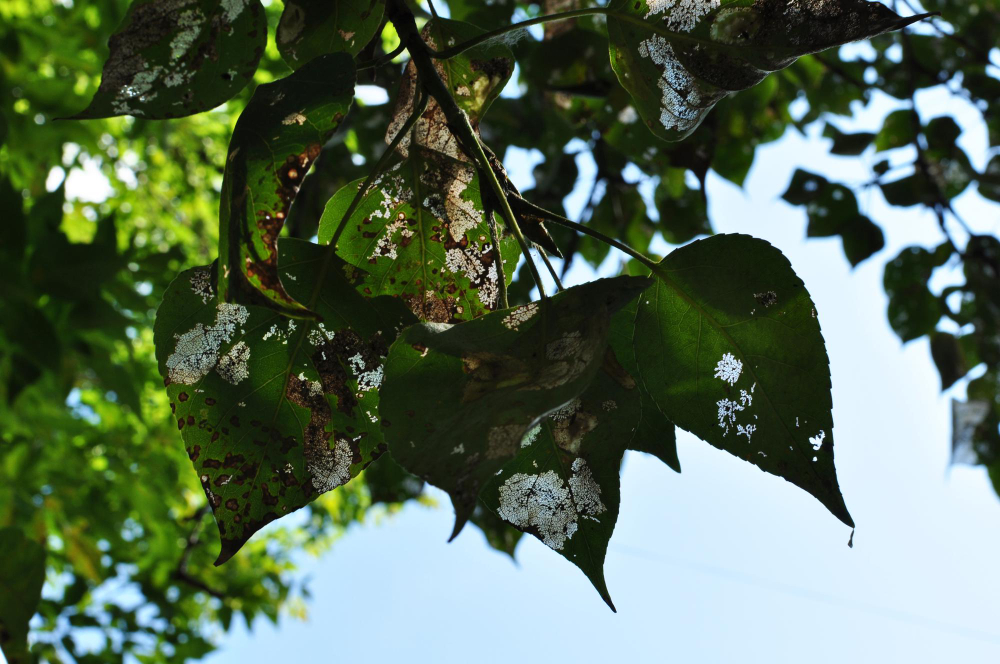
Japanese beetles and other summer pests attacking Ohio trees in 2026 are not waiting for you to notice them. By the time skeletonized leaves, sticky honeydew residue, or D-shaped exit holes catch your eye, the damage is often weeks ahead of your response. Summer is the most active pest season for Ohio's landscape trees, and this year brings the added pressure of a statewide spotted lanternfly quarantine that the Ohio Department of Agriculture expanded to all 88 counties effective February 17, 2026.
The pests covered in this article range from annual nuisances that healthy trees can weather to invasive threats that kill untreated trees within a few years. Knowing what to look for, when to act, and when to call a professional is the difference between catching a problem early and spending thousands on emergency removal of a tree that could have been saved.
This article covers the summer pests that Ohio homeowners are most likely to encounter this season, organized by the level of threat they pose to your trees and the urgency of the response each one requires.
In this article, you will learn about:
- Japanese beetles and the damage cycle that starts in your lawn
- Spotted lanternfly and what Ohio's statewide quarantine means for your property
- Emerald ash borer and why untreated ash trees are now critical hazards
- Bagworms, scale insects, and other summer pests that weaken trees over time
- When DIY management works and when you need a certified arborist
Keep reading to identify what is eating your trees this summer and respond before the damage compounds.
Japanese beetles and the damage cycle that starts in your lawn
Japanese beetles are the most visible summer pest on Ohio landscape trees, and their annual arrival in late June through July triggers more homeowner calls than almost any other insect. The metallic green-and-copper adults are hard to miss. They congregate on foliage in groups, feed in broad daylight, and can reduce a tree's leaves to lace-like skeletons in a matter of days when populations are heavy.
But the damage you see on the leaves is only half the story. The beetles' lifecycle begins underground as white grubs feeding on turfgrass roots, and the lawn damage from grubs often goes unnoticed or gets blamed on drought until the connection is made. Understanding both phases of the lifecycle is essential to managing the problem effectively.
Which Ohio trees get hit hardest and which ones beetles ignore
Japanese beetles feed on over 300 plant species, but they have strong preferences. According to researchers at Ohio State University, certain trees and shrubs attract heavy feeding pressure while others are almost never touched. Knowing what you have on your property tells you where to focus your attention.
Trees and shrubs Japanese beetles prefer in Northeast Ohio:
- Lindens (basswoods), which are among the most heavily attacked trees in the region
- Japanese maples, birches, and crabapples
- Roses, grape vines, and members of the rose family broadly
- Elms, willows, and purple-leaf plums
Trees Japanese beetles rarely attack:
- Red and silver maple, red oak, and tuliptree
- Dogwood, holly, boxwood, and magnolia
- Spruce, juniper, arborvitae, and most conifers
- Redbud, forsythia, lilac, and yew
If your property is planted heavily with species on the preferred list, you can expect annual pressure and should plan accordingly. If your landscape leans toward the resistant list, your trees will likely come through beetle season with minimal damage.
Managing beetles without killing the pollinators working alongside them
The instinct when Japanese beetles appear in force is to reach for a broad-spectrum insecticide and spray everything in sight. That approach often causes more harm than the beetles themselves, because it also kills the bees, beneficial wasps, and predatory insects that are working the same plants.
A more measured approach targets the pest without collapsing the beneficial insect community:
- Hand-picking beetles into a bucket of soapy water is the most targeted method available. It sounds tedious, but it is highly effective on small to medium trees and garden plantings, especially in the early morning when beetles are sluggish.
- Neem oil and products containing the active ingredient azadirachtin act as feeding deterrents. They do not kill beetles on contact but make treated foliage unpalatable and reduce feeding damage over the course of the season.
- For high-value landscape trees that take heavy damage year after year, systemic trunk injections applied by a certified arborist can provide season-long protection without exposing pollinators to surface residues. The systemic is taken up into the tree's vascular system and affects only insects that feed on the treated tissue.
- Avoid Japanese beetle traps. Research from multiple university extension programs, including Ohio State, has repeatedly shown that the pheromone and floral lures in these traps attract far more beetles to your property than they capture, increasing the damage to surrounding plants rather than reducing it.
Grub control in the lawn addresses the underground half of the lifecycle. Preventive treatments applied in late spring through early summer target grubs while they are small and near the soil surface. Late summer treatments between July and August work on the current year's grub population before they burrow deep for winter. A healthy lawn without a severe grub infestation produces fewer adult beetles the following summer, gradually reducing the pressure on your trees over successive years.
Spotted lanternfly and what Ohio's statewide quarantine means for your property
Spotted lanternfly is the invasive pest that has dominated Ohio agriculture and forestry news since it was first confirmed in the state at Mingo Junction in 2020. The situation escalated significantly in early 2026 when the Ohio Department of Agriculture expanded the quarantine from 18 counties to all 88, making Ohio the latest state to implement statewide restrictions on the movement of trees, nursery stock, and other products that could harbor the pest.
For homeowners, the quarantine's practical effects are mostly felt by the nursery and landscaping industries. But the pest itself is a direct concern for anyone with trees on their property, particularly if you have tree of heaven, black walnut, grapevines, or fruit trees.
Identifying spotted lanternfly at every stage of its lifecycle
Spotted lanternfly goes through distinct visual stages between spring and fall, and knowing what to look for at each one prevents you from walking past an infestation that is building on your trees.
The lifecycle progresses through these stages in Ohio:
- Egg masses (fall through early spring): flat, gray-brown mud-like smears on tree trunks, branches, fence posts, outdoor furniture, and almost any flat surface. Each mass contains 30 to 50 eggs. These survive winter and hatch in spring.
- Early nymphs (April through June): small, black with white spots. They hop more than they fly and congregate on new growth and soft stems.
- Late nymphs (July through August): larger, red with black and white spots. This stage is distinctive and easier to identify than the early nymphs.
- Adults (July through November): approximately one inch long with tan, spotted forewings. The bright red hindwings with black patches are visible only when the wings are spread or the insect is in flight.
Adults feed by piercing plant tissue and extracting sap, which weakens the host and produces large quantities of sticky honeydew that coats surfaces below the feeding site. That honeydew promotes sooty mold growth, which is the black, grimy residue homeowners often notice on decks, cars, and patio furniture beneath infested trees.
What homeowners should do about spotted lanternfly right now
The Ohio Department of Agriculture is no longer asking residents to report individual sightings, given the statewide scope of the infestation. Instead, the focus has shifted to direct management on your own property.
If you find spotted lanternfly or their egg masses on your property, these are the recommended steps:
- Scrape egg masses off surfaces into a container of rubbing alcohol or hand sanitizer to destroy them. Fall through early spring is the ideal window for this, but late-discovered masses should still be removed.
- Kill individual nymphs and adults by squishing them or spraying them with white vinegar. Adults can fly short distances, so act quickly when you spot them.
- Remove tree of heaven from your property if it is present. Tree of heaven is the spotted lanternfly's preferred host, and leaving it standing creates a magnet that concentrates the pest population near your other trees. Professional removal with herbicide treatment of the root system is recommended, since cutting alone triggers aggressive resprouting.
- For high-value trees that are being heavily fed upon, contact a certified arborist about targeted treatment options. Systemic insecticides applied by trunk injection can reduce lanternfly feeding on individual trees without broad environmental exposure.
Spotted lanternflies are not known to kill most tree species outright, but heavy, repeated feeding weakens trees over successive seasons, making them more susceptible to secondary pests and diseases and reducing their ability to recover from storms and drought stress. Grapevines and black walnut saplings are exceptions, as lanternfly feeding can kill these directly.
Emerald ash borer and why untreated ash trees are now critical hazards
Emerald ash borer is not a new pest in Ohio, but it remains one of the most consequential. EAB has been present in the state since 2003 and has spread to every county. The Ohio Department of Natural Resources has documented how the larvae bore beneath the bark and sever the tree's ability to transport water and nutrients, killing untreated ash trees within roughly three to five years of infestation.
By summer 2026, the vast majority of unprotected ash trees in Ohio are either dead or in advanced stages of decline. The issue for homeowners now is less about preventing infestation and more about dealing with the hazard that dead and dying ash trees represent on their property.
Dead ash trees become brittle quickly. They lose structural integrity faster than most hardwoods, and branches and trunks can fail without warning in moderate wind. A dead ash standing near a house, driveway, walkway, or play area is a serious liability that should be addressed before the next storm season, not after.
If you have ash trees on your property, here is how to assess the current situation:
- Canopy still full and green with no visible decline: the tree may still be a candidate for preventive treatment. Trunk injections applied between early May and mid-June are the most effective method. Consult an arborist to evaluate whether treatment is still viable.
- Canopy thinning from the top down, with visible deadwood and epicormic sprouting along the trunk: the tree is in active decline and may or may not respond to treatment depending on how much vascular tissue remains functional. An arborist assessment is critical before investing in treatment at this stage.
- Canopy mostly dead, bark sloughing, D-shaped exit holes visible: the tree is past saving and should be removed as a safety priority. Dead ash removal is more hazardous than removing a living tree because the wood is brittle and unpredictable, so this is firmly a professional job.
Bagworms, scale insects, and other summer pests that weaken trees over time
Not every summer pest is an emergency. Several common insects that show up on Ohio trees between June and September cause real damage but rarely threaten the life of a mature, healthy tree in a single season. The risk from these pests is cumulative: repeated years of heavy feeding gradually weaken the tree's ability to photosynthesize, recover from storms, and resist secondary infections.
Managing these pests is part of a proactive tree health care approach rather than an emergency response.
Bagworms stripping conifers one branch at a time
Bagworms are native moth larvae that build distinctive spindle-shaped bags from silk and bits of foliage. They are most commonly found on arborvitae, juniper, spruce, and other conifers in Ohio landscapes, though they can also feed on deciduous trees. Heavy infestations can defoliate an evergreen completely, and unlike deciduous trees, conifers cannot regrow lost needles. A fully defoliated branch on a spruce or arborvitae is a dead branch.
The management window is narrow. Bagworms hatch in mid-June in Ohio and are easiest to kill while the larvae are small and actively feeding. By late summer, the bags are sealed and the caterpillars inside are protected from most treatments.
For small plantings, hand-picking the bags off the tree and dropping them in soapy water is effective and requires no chemicals. For larger trees or heavy infestations, a targeted application of Bt (Bacillus thuringiensis), a biological insecticide that affects only caterpillars, is effective when applied during the active feeding window in late June through early July.
Scale insects and the slow decline they cause over multiple seasons
Scale insects are among the most commonly overlooked tree pests in Ohio because they do not look like insects at all. They appear as small bumps on bark and twigs, ranging from waxy white to dark brown depending on the species, and they feed by piercing plant tissue and extracting sap. Individual scales cause negligible damage. Heavy populations, building over several years of unchecked growth, can reduce vigor, cause branch dieback, and produce enough honeydew to coat everything beneath the canopy in a sticky, sooty mess.
Common scale species on Northeast Ohio trees include:
- Lecanium scale on oaks, maples, and elms, producing large, dome-shaped brown shells on twigs
- Euonymus scale on euonymus and pachysandra, appearing as tiny white streaks on stems and leaves
- Pine needle scale on spruce and pine, showing as small white dots on needles
Horticultural oil applied during the dormant season (late winter to early spring) smothers overwintering scales before they become active. During the growing season, treatment timing targets the crawler stage, when the juvenile scales are mobile and vulnerable, which typically occurs in late May through June in Ohio. An arborist can identify the specific scale species on your trees and recommend the correct treatment timing.
Aphids, lace bugs, and spider mites in hot, dry stretches
Hot, dry summer weather in Ohio triggers population explosions of several sap-feeding pests that thrive when humidity drops and natural enemies are less active. Aphids cluster on new growth and the undersides of leaves, producing honeydew and causing leaf curling. Lace bugs feed on the undersides of leaves on sycamore, oak, and hawthorn, leaving a bleached, stippled appearance on the upper surface. Spider mites, which are technically arachnids rather than insects, cause similar stippling and bronzing on a wide range of species during prolonged dry periods.
In most cases, a strong blast of water from a garden hose is enough to knock aphid and mite populations down to manageable levels on small trees. Lace bugs are harder to dislodge but rarely cause long-term harm to a healthy, well-watered tree. The best defense against all three is maintaining tree health through proper watering, mulching, and soil management, because a well-hydrated tree with a functioning root system can tolerate moderate pest pressure without intervention.
When DIY management works and when you need a certified arborist
The pests in this article span a wide range of severity, and the right response depends on the pest, the tree, and the scale of the problem. Knowing where the line falls between effective homeowner action and professional intervention keeps you from wasting time on a problem that needs expert treatment, or from calling a tree company for something you can handle with a bucket of soapy water.
Situations where DIY management is appropriate:
- Hand-picking Japanese beetles from small trees and garden plants during peak season
- Scraping spotted lanternfly egg masses from tree trunks, fences, and outdoor surfaces
- Knocking aphid or spider mite populations down with a strong water spray on small to medium trees
- Hand-removing bagworm bags from reachable branches on shrubs and small evergreens
- Applying preventive grub treatments to your lawn following product label directions
Situations where you need a certified arborist:
- Evaluating ash trees for emerald ash borer viability and administering trunk injections
- Treating large, high-value trees for Japanese beetle, scale, or other pests with systemic injections that require specialized equipment
- Assessing and removing dead or declining trees that pose a fall hazard, especially dead ash
- Diagnosing the cause of canopy dieback, leaf drop, or branch failure when the pest is not visually obvious
- Developing a multi-year plant health care program that addresses the specific pest and disease pressures on your property
The threshold is straightforward: if the problem involves a large tree, a potentially lethal pest, specialized equipment, or a diagnosis you are not confident about, that is when professional evaluation pays for itself.
Conclusion
Summer pest season in Ohio is not a single event. It is a rolling window from late spring through fall where different insects peak at different times, each targeting different species and requiring different responses. Japanese beetles skeletonize foliage in July. Spotted lanternfly nymphs build through spring and summer. Emerald ash borer kills silently beneath the bark year-round. Bagworms, scale, and mites compound their damage across seasons.
The homeowners who keep their trees healthy through all of this are the ones who monitor regularly, respond to the right pests with the right methods at the right time, and bring in professional help when the situation exceeds what a garden hose and a bucket of soapy water can address. Ohio's pest landscape is more complex in 2026 than it was even five years ago, with the statewide spotted lanternfly quarantine and the ongoing emerald ash borer crisis adding layers of urgency that did not exist before.
If your trees are showing signs of pest damage this summer, or if you have ash trees that have not been evaluated, do not wait for the problem to announce itself with a fallen branch or a dead canopy. Premier Tree Specialists provides ISA Certified Arborist assessments, targeted pest treatment, plant health care programs, and tree removal across Northeast and Central Ohio. Schedule a consultation and get ahead of the damage while treatment options are still on the table.
