


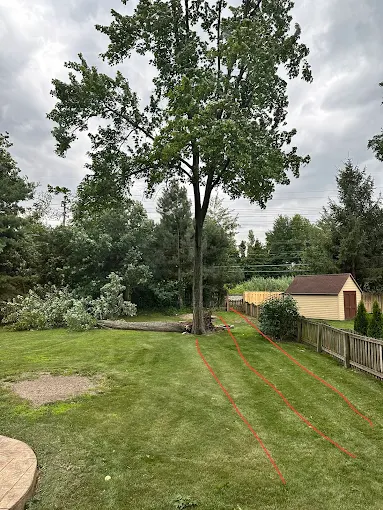
Tree maintenance is one of the most overlooked ways Delaware County homeowners protect the value and safety of their properties. It is easy to think of trees as something that just grows on its own, but a neglected tree does not stay neutral for long. It becomes a liability.
The trees on your lot are doing real work, year in and year out. They shade your roof in July, buffer wind in February, hold soil in place after hard spring rains, and add genuine dollar value to your home. But all of that only holds when the trees are healthy and properly cared for. A dead limb, a diseased trunk, or roots pushing into your foundation do not fix themselves. They get worse.
Delaware County sits in central Ohio, which means your trees face the full range of stress the Midwest can throw at them: ice storms, drought summers, early-season freezes, and pest pressure from insects like Japanese beetles that have been increasingly problematic in recent years. This article covers what regular tree care actually does for your property in each season, and why skipping it costs more than the work itself.
In this article, you will learn about:
- How healthy trees protect and raise the value of your Delaware County home
- What winter and spring tree maintenance prevents
- The summer risks that most homeowners don't catch in time
- How fall preparation sets your trees up for a safe winter
- When to call a certified arborist instead of waiting
Keep reading to understand exactly which threats regular tree maintenance blocks before they become expensive emergencies.
Healthy trees are doing financial work on your property
Before getting into seasonal specifics, it helps to understand the stakes. Trees are not decorative. They are structural and financial assets that require active upkeep to stay that way.
Research from the University of Nebraska-Lincoln's Bureau of Business Research found that trees add more than $31.5 billion to private home property values annually across the country. That number represents what well-maintained trees contribute, not what neglected ones do. A dead or structurally compromised tree works in the opposite direction: it is a hazard that buyers notice, appraisers discount, and insurance companies sometimes refuse to cover.
The USDA Forest Service has documented that strategically placed trees can reduce home air conditioning costs by as much as 56 percent. In Delaware County summers, where temperatures regularly push into the 90s, that kind of shade is not trivial. It is direct monthly savings.
Beyond the energy and value angles, there is the liability piece. When a tree on your property falls and damages a home or vehicle, insurers look closely at maintenance history. A tree that was clearly diseased or dead before the storm may not be covered, leaving you on the hook for repairs that can run into tens of thousands of dollars. Regular maintenance is the paper trail that shows your trees were being managed responsibly.
What "maintained" actually means for a Delaware County property
Tree maintenance is not a single service. It is a combination of seasonal tasks that work together to keep your trees structurally sound, disease-free, and properly sized for your lot.
The core services that make up a sound maintenance program include:
- Trimming and pruning to remove dead, crossing, or structurally weak branches
- Annual or biannual arborist inspections to catch disease and structural problems early
- Plant health care treatments for pests, fungal issues, and nutrient deficiencies
- Proper mulching to retain moisture and protect root systems
- Stump removal after any tree is taken down, to eliminate disease reservoirs and tripping hazards
None of these tasks is urgent in isolation. Together, they add up to a property that looks well-kept, performs efficiently, and does not surprise you with a $15,000 roof repair after a windstorm.
The trees most likely to cause problems in Delaware County
Not every tree carries the same risk. Some species common to Delaware County are more prone to structural failure, disease, or root issues than others.
Ohio homeowners tend to see the most problems from:
- Silver and Norway maples, which develop weak branch unions and split under ice loads
- Ash trees, which have been devastated by the emerald ash borer beetle across Ohio
- Bradford pears, a popular ornamental tree known for splitting at the central trunk as it ages
- Cottonwoods near drainage areas, which grow fast but develop soft wood prone to storm breakage
Knowing what you have on your lot is the first step. A certified arborist inspection puts a professional set of eyes on every tree and flags the ones that need attention before they become the kind of problem you read about in a homeowner's insurance claim.
What winter does to your trees, and what you can do before it hits
Ohio winters are not kind to trees. Delaware County gets ice storms, heavy snow accumulation, and freeze-thaw cycles that stress bark, crack branch unions, and expose wounds to disease. Most of the damage that shows up in spring started the previous winter and built quietly all season.
The most dangerous pattern is ice loading. When ice accumulates on branches, the weight can be two or three times what a branch was ever designed to hold. A branch that was already weakened by disease, poor structure, or an old wound is the one that comes down on your fence or car at 2 a.m. during a January storm. Winter tree damage in Ohio is almost always preventable when the right work is done in fall.
Fall prep: the work that prevents winter emergencies
The best time to prepare your trees for winter is before the ground freezes. Fall is when arborists look for structural weaknesses that will fail under snow and ice load.
A solid fall tree prep routine covers:
- Removing dead, cracked, or structurally weak limbs before ice adds weight to them
- Inspecting for signs of disease and decay inside the trunk or at branch attachments
- Installing cabling and bracing for large trees with split unions or heavy lateral limbs
- Applying mulch to protect root systems from freeze-thaw heaving
- Identifying trees that are at or past the end of their structural life and scheduling removal before winter
The goal is to arrive at December with a property where every tree standing is standing for the right reasons. A full pre-fall checklist covers these tasks in the sequence arborists recommend for central Ohio conditions.
After a winter storm: what to assess
Once a major ice or snow event passes, walk your property before the next melt. Look for:
- Hanging branches still attached to the tree but cracked through
- Splits at branch unions where two major limbs meet the trunk
- Bark that has been stripped or torn by a falling branch
- Trees leaning more than they were before the storm
Hanging limbs are the most immediate hazard. They can fall without warning days or weeks after the storm once the weight shifts. Do not try to knock them down yourself. Call a professional who can remove them safely from the ground or with proper climbing equipment. Storm damage tree removal after a major Ohio event is time-sensitive work.
Spring maintenance: the season most homeowners underinvest in
Spring is when Delaware County homeowners notice their trees again after months of ignoring them. It is also the most important maintenance window of the year for most species. The work done in March and April sets the biological and structural baseline for everything that follows.
As trees break dormancy, their vascular systems are under high pressure and actively growing. This is the window when trimming is most effective for most deciduous species, wounds close fastest, and disease inoculants are easiest to apply. It is also when fungal diseases like oak wilt and fire blight make their first moves. Waiting until summer to address spring problems means the disease has had a full growing season to spread.
What a spring arborist visit covers
A proper spring visit from a certified arborist is not just a visual check. It is a systematic evaluation of every tree on your property.
The arborist is looking for:
- Winter dieback: branches that did not leaf out or leafed out weakly
- Signs of bark damage from frost cracking or vole activity at the base
- Early indicators of borers and scale insects, which become visible as new growth emerges
- Structural wounds that opened up over winter and now need treatment or monitoring
- Trees that leafed out unevenly, which often signals root stress or vascular disease
Catching any of these in spring gives you treatment options. By fall, some of those same issues have progressed to the point where removal is the only viable answer.
Root problems that surface in spring
Spring rains in Delaware County can be heavy, and that is when root issues reveal themselves. Soil heaving, new cracks in driveways or sidewalks, and foundation settling near large trees are all signs that roots have been quietly expanding into places they should not be.
Root problems in Ohio are common in older neighborhoods where large maples and oaks have had decades to spread, and the damage to foundations and pipes can be significant. The cost of addressing it goes up every year the tree stays untreated. If you have a large tree within 15 to 20 feet of your foundation, a spring root assessment is worth adding to your maintenance schedule.
Summer: drought, pests, and the problems you don't see coming
Summer feels like the calm season for trees, but it is actually when stress accumulates fastest. Delaware County summers can run hot and dry for weeks at a time, and drought stress is one of the primary reasons trees fail structurally in subsequent storms. A tree that went through a dry summer with no supplemental care is significantly more vulnerable to the fall and winter that follow.
Drought stress does not kill trees overnight. It weakens them gradually, reducing their ability to close wounds, resist disease, and maintain structural wood density. A tree that looks fine in August may have lost significant mechanical strength in its root system and branch wood.
Pest pressure peaks in summer
Summer is prime season for the insects that do the most damage to Ohio trees. Emerald ash borer, Japanese beetles, and various scale insects all peak in their activity between June and September.
The problem with most pest infestations is that by the time you see the damage, the population is already large. Japanese beetles in particular can defoliate a tree quickly enough to cause significant stress in a single season. Repeated defoliation over two or three years often precedes structural failure.
Signs of summer pest activity to watch for:
- Skeletonized leaves (usually Japanese beetles or caterpillars)
- D-shaped exit holes in bark (emerald ash borer)
- Premature leaf drop or wilting on one branch or section
- Sawdust-like frass at the base of the trunk
- Soft or spongy bark on a section of the trunk
If you see any of these, do not wait for fall to have someone look at it. Summer pest treatment windows are narrow. An ISA-certified arborist can identify the pest, confirm whether treatment is viable, and tell you honestly whether the tree is worth saving.
Trees that are too close to the house
Summer growth makes an existing problem more visible. If you have branches rubbing your roof, a canopy that overhangs your gutters, or a trunk that seems closer to your siding than it should be, summer is the right time to have that assessed.
A tree too close to the house creates multiple overlapping risks: moisture retention on your roof, debris accumulation in gutters, a direct path for squirrels and carpenter ants into your attic, and a liability issue if the tree ever fails. The fix is usually crown reduction or crown thinning, not removal. But that work is best done before summer growth pushes the canopy further into the structure.
When a tree has crossed the line from liability to emergency
Regular maintenance is what keeps trees out of the emergency category. But even well-maintained properties in Delaware County end up with trees that need to come down. Part of responsible property management is being able to read the warning signs before the decision gets made for you by a storm.
The distinction between a tree that needs trimming and one that needs removal is not always obvious from the ground. What looks like a healthy tree can have a hollow core, advanced fungal decay at the root flare, or a root system that has been significantly compromised by construction or disease. These are conditions that require an experienced arborist's assessment, not a visual check from your driveway.
Some clear indicators that a tree has moved into removal territory:
- Major sections of dead wood in the crown, especially on the side facing the house
- Mushroom or conk growth at the base of the trunk, which signals internal decay
- A visible lean that has increased over one season
- Bark that has separated from the trunk in large sections
- A trunk wound that has not closed after two or three growing seasons
The Insurance Information Institute data cited in Davey Tree's research shows that after filing a single storm-related tree claim, homeowners can expect their rates to rise by an average of 9 percent. A proactive removal that costs a few hundred to a few thousand dollars is a far better outcome than a winter storm bringing a dead oak through your roof and a rate increase on top of it.
What it actually costs vs. what you risk
Removal costs vary significantly by tree size, location, and complexity. A routine job on an open lot is very different from extracting a 70-foot oak overhanging a garage. Getting a clear number upfront is the starting point for making a sound decision.
What homeowners often do not account for is the full cost of waiting. A tree that falls on a structure creates:
- Structural repairs to the home, potentially not fully covered if the tree was in poor condition
- Stump removal on an emergency timeline, which costs more than scheduled work
- Possible liability if the tree crosses a property line onto a neighbor's home or vehicle
- Cleanup costs that are separate from repair costs
Most homeowners who have been putting off a removal are surprised by how quickly the work gets done once a crew is on site. The hesitation is almost always worse than the job itself.
Conclusion
Tree maintenance in Delaware County, OH is not optional upkeep for people who like gardening. It is a core part of managing a property safely and protecting a significant financial asset. The trees on your lot are affected by every season Ohio throws at them, and the ones that fail almost always had warning signs that regular inspection and care would have caught.
The investment in routine trimming, annual arborist visits, and prompt attention to diseased or structurally compromised trees pays back in lower emergency costs, maintained property value, and a home that is genuinely safer in an Ohio winter.
If you are not sure where your trees stand, the best next step is a professional assessment. Premier Trees provides certified arborist services throughout Delaware County and the surrounding Ohio area. Contact the team to schedule an inspection and get a clear picture of what your property actually needs.
